 tokconnect
Yes, TikTok has AI, and a lot of it. Some of it is built for you to use, like turning a photo into a short video or making an avatar of yourself. Some of it runs in the background, deciding what you see and labelling clips that were made by a machine. And some of it belongs to advertisers, who now build whole ads with TikTok's own tools. This page walks through every TikTok AI feature that matters in 2026, the rule about labelling AI content, and what all of it means whether you post, watch or advertise.
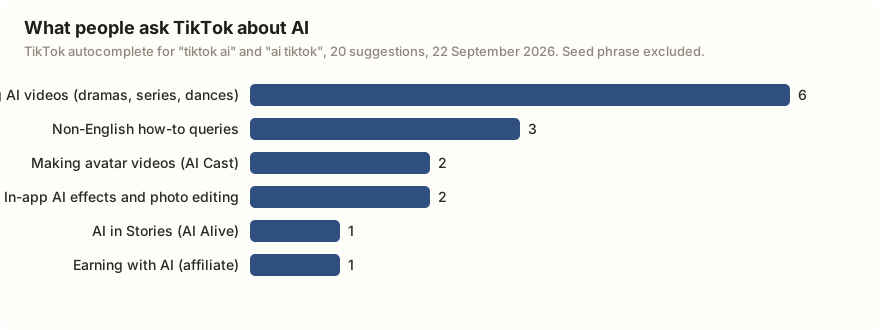
We also pulled what people actually type into TikTok's search box when they look for "ai". Almost every suggestion is about making or watching AI videos. Not one is about labels, disclosure or turning AI off. That tells you where the attention is, and where the confusion is.
TikTok AI features you can use
TikTok has quietly added a set of AI tools you tap inside the app. These are the three most people run into.
AI Alive turns a still photo into a short moving video. It lives in the Story Camera: pick a photo, add a prompt, and TikTok animates it. TikTok launched AI Alive on 13 May 2025. Every clip it makes carries an "AI-generated" label and hidden Content Credentials baked into the file, so you do not have to label it yourself.
AI Self lets you upload a selfie to build an avatar of yourself, then make videos from a template or a written prompt without filming again. It was first documented on 29 December 2024. It still exists in the app, though TikTok has not confirmed its exact 2026 status, so treat the details as a moving target. TikTok's related AI Cast feature, which several of the search suggestions above ask about, builds videos from an authorised AI Self.
Manage topics is newer and points the other way: it is about seeing less AI, not making it. TikTok announced it on 18 November 2025. Go to Settings and privacy, then Content and display, then Content preferences, then Manage topics. There you get a slider for AI-generated content in your For You feed. You can drag it to show more or less, but you cannot turn AI off completely, as reported at launch.
TikTok also tested AI search summaries, called "AI search highlights" and powered by ChatGPT, back in May 2024. There has been no confirmed wide rollout since, so do not count on it being there.
The AI label rule and Content Credentials
If you post something realistic that was made or heavily edited by AI, TikTok's rules say you have to label it. This has been the rule since 19 September 2023. There is a manual toggle at upload for it. It covers realistic AI images, audio and video, the kind a viewer could mistake for real. TikTok can remove realistic AI content that is not disclosed.
Some labelling happens on its own. TikTok joined the C2PA Content Credentials standard on 9 May 2024 and was the first video platform both to auto-label uploads that arrive with those credentials and to attach credentials to its own AI content. Anyone can check a file for them at the free C2PA Verify site. From May 2024, uploads carrying C2PA credentials and clips made with TikTok's own AI effects started getting labelled automatically. On 18 November 2025 TikTok said it would also add an invisible watermark that only TikTok can read. A further Community Guidelines update is announced, effective 24 September 2026.
If your video looks real and was made with AI, label it. The toggle is right there at upload. Skip it on a realistic clip and TikTok can take the video down under the rule that has run since September 2023. The safe habit: if a viewer could think it was filmed for real, turn the label on.
AI and getting paid on TikTok
People keep asking whether AI videos still earn money. The honest answer: it depends on the video, not on the fact that AI touched it.
The Creator Rewards Program is TikTok's main payout for longer videos. It rewards videos that are original, over one minute long, useful in search, and that people actually engage with. It excludes unoriginal or low-quality videos, and it names "slide videos", the photo-slideshow kind, as an example of what it will not pay for.
Notice what that list does not say. TikTok has not published any statement that bans AI-generated content from the program specifically. So do not believe a post that claims AI is banned from monetisation. A lazy AI slideshow fails the originality and quality bar the same way a lazy human slideshow does. An original, longer video that happens to use an AI tool is judged on the video.
TikTok AI for advertisers
If you buy ads, TikTok gives you its own AI to make and run them. Two names cover most of it.
Symphony is TikTok's AI creative suite. It writes scripts, generates and edits video, dubs clips into other languages, and can build AI avatars that read your copy. Smart+ is the automated campaign product: you give it the goal and assets, and it handles targeting, bidding and which creative to show. TikTok expanded both heavily through 2025, and the two are wired together so Symphony creative feeds straight into Smart+ campaigns.
There is also a way to run this through an AI agent instead of the ads dashboard. TikTok has an Ads MCP that lets a tool like Claude talk to your ad account. We cover how that works, and how it differs from the research MCP, on the TikTok MCP guide.
The AI-slop side of TikTok
Not all of TikTok's AI is a feature. A growing share of the app is low-effort AI video, the kind people call "AI slop". Cheap AI video generators and faceless AI accounts can churn out dozens of clips a day with no camera and no face.
The scale is hard to pin down, but the reporting is not flattering. A 2026 study reported by The Next Web found that roughly 6 in 10 of the videos served to brand-new accounts were AI-generated, with children's content the worst hit. Coverage also describes phone farms, racks of real handsets running software to warm up accounts and flood the feed. Treat these figures as reported findings, not TikTok's own numbers, but they match what the Manage topics slider is quietly responding to.
For an ordinary viewer the takeaway is simple: the slider above lets you push some of this out of your feed, and the AI label helps you spot the realistic stuff.
Reading TikTok's AI data with an agent
The last piece of "TikTok AI" is not inside TikTok at all. It is the AI agents that read TikTok data for you. Instead of scrolling, you can point a tool like Claude or ChatGPT at TikTok's search and trends data and ask it questions in plain English, through an MCP connection. That is how you would measure AI demand in your niche, or watch a topic climb, without opening the app fifty times. The browser-agent guide shows an agent doing the clicking for you.
Search TikTok topics and autocomplete for "ai". List every topic with its 7-day searches and video count. Mark which ones are content gaps with almost no videos, and group the autocomplete suggestions by what people want: making AI videos, in-app effects, or something else. Give me the three topics with the most searches and the fewest videos.
Works in Claude, ChatGPT, Cursor and Gemini once TokConnect is connected. Get a free key (100 credits, no card) or see the setup guides.
Run that once a week and you will know whether AI is a rising search in your corner of TikTok, or just noise in the feed, before you spend a day making a video about it.
Frequently asked questions
Does TikTok have AI?
Yes, in several forms. You can make videos with tools like AI Alive (photo to video) and AI Self (an avatar of you). You can control how much AI you see with the Manage topics slider added in November 2025. TikTok auto-labels a lot of AI content, and advertisers get a full AI suite called Symphony.
How do I label AI content on TikTok?
There is a toggle at the upload screen to mark a video as AI-generated. Turn it on for any realistic AI image, audio or video before you post. Clips made with TikTok's own AI tools, and files that arrive with C2PA Content Credentials, are labelled automatically, so you do not always have to.
Can I use AI videos on TikTok?
Yes. AI videos are allowed as long as you label realistic ones. TikTok's rule, in place since 19 September 2023, is about disclosure, not a ban. Undisclosed realistic AI can be removed, and low-effort AI slideshows tend to get little reach.
Does AI content get monetised on TikTok?
It can. TikTok has not published any statement banning AI-generated content from the Creator Rewards Program. The program pays for videos that are original, over one minute, useful in search and engaging, and excludes low-quality ones such as slide videos. An original longer video that uses an AI tool is judged on the video, not on the tool.
How do I see less AI on TikTok?
Open Settings and privacy, then Content and display, then Content preferences, then Manage topics. There is a slider for AI-generated content in your For You feed. Drag it down to see less. You cannot switch AI off entirely, only reduce it.
What is TikTok Symphony?
Symphony is TikTok's AI creative suite for advertisers. It can write scripts, generate and edit video, dub clips into other languages and build AI avatars. It feeds into Smart+, TikTok's automated campaign product, which handles targeting, bidding and creative selection for you.
Sources and data
- TikTok launches TikTok AI Alive (TechCrunch, 13 May 2025)
- How TikTok AI Alive works (Metricool)
- TikTok debuts new tools to label AI content (TechCrunch, 19 Sep 2023)
- TikTok takes a clearer stance against AI misinformation (MediaPost)
- TikTok adds Content Credentials, auto-labels AI uploads (PetaPixel, 9 May 2024)
- TikTok lets you choose how much AI content you see (TechCrunch, 18 Nov 2025)
- TikTok adds option to limit AI content in your For You feed (Social Media Today)
- TikTok revamps Creator Rewards to incentivise longer videos (Social Media Today)
- Nearly 60% of TikTok videos shown to new users are AI slop, study finds (The Next Web, 2026)
- TikTok search suggestions for "tiktok ai" and "ai tiktok", pulled 22 September 2026 (snapshot)