
- TikTok's own 2020 post names three signal groups (your interactions, video information, device and account settings), says a strong signal like finishing a video outweighs a weak one, and says follower count is not a direct factor. Nothing published since replaces it.
- The small-test-then-wider model is a fair inference from how views arrive, but TikTok has not published batch sizes, time windows or pass marks for creators; one seller education page mentions about 500 people for sellers. Numbers like "the first 200 viewers" are guesses.
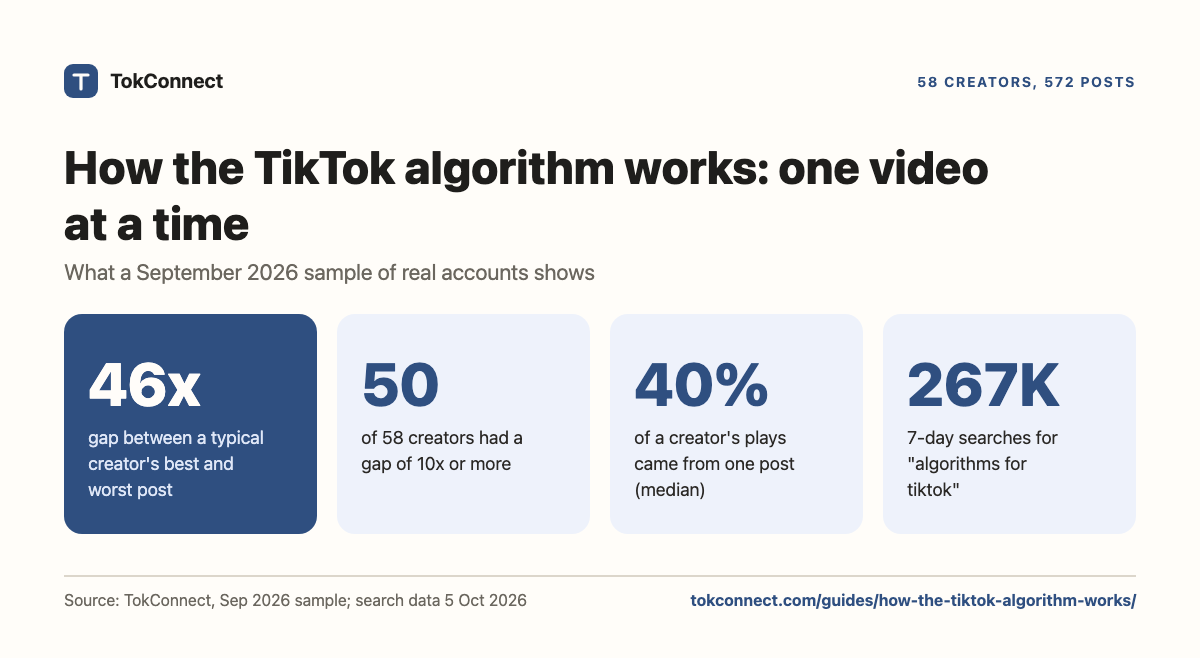
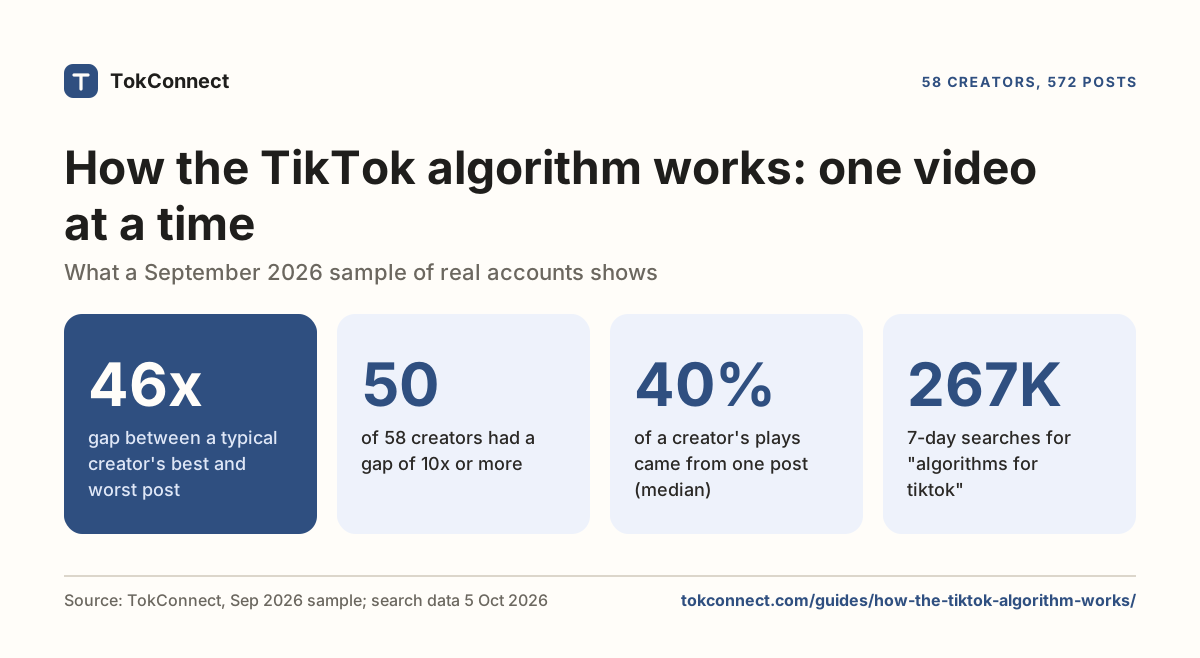
- In a September 2026 sample of 58 creators, the typical creator's best post got 46 times the plays of their worst over ten posts, and 50 of 58 had a gap of at least 10 times. One weak post is the normal shape, not a penalty.
- Shadowban, posting time, hashtags, links, deleting videos and warming up an account are each answered with what TikTok has said and what the data shows. Most reduce to the same mistake: treating one video's result as a verdict on the account.
- To retrain your own feed: Settings and privacy, Content preferences, Refresh your For You feed, then Not interested, Manage topics and Keyword filtering.
The TikTok algorithm is the system that picks which videos land on your For You feed, and it works one video at a time: for each video it guesses how likely you are to watch to the end, like, share or save, based on what you did with earlier videos, and shows the ones it rates highest. In a September 2026 sample of 572 posts from 58 creators, the typical creator's best recent post got about 46 times the plays of their worst, which is what judging every video on its own looks like.
That much TikTok has said itself. Most of the rest of what people repeat about the TikTok algorithm is guesswork. This page sorts the claims into three piles, what TikTok has published, what real posting data shows, and what creators report, and labels each one.
What has TikTok published about the algorithm?
The fullest description is still TikTok's own newsroom post from June 2020. It names three groups of signals. First, your interactions: the videos you like and share, the accounts you follow, the comments you post and the videos you make. Second, video information: captions, sounds and hashtags. Third, device and account settings: your language, country and device type. TikTok says the third group carries less weight, because you never chose those as preferences.
Two more points from the same post settle most arguments. A strong signal, such as finishing a long video, counts for more than a weak one, such as the viewer and the creator being in the same country. And neither follower count nor a creator's earlier hits is a direct factor in whether a video gets recommended. Both are still quoted as current by Sprout Social (February 2026) and Hootsuite (June 2026), and TikTok has published nothing that replaces them.
Since 2020 TikTok has published controls rather than mechanics.
| When | What TikTok published | What it does |
|---|---|---|
| June 2020 | How TikTok recommends videos #ForYou | Names the three signal groups, strong versus weak signals, and says follower count is not a direct factor |
| March 2023 | Refresh your For You feed | Resets your recommendations so the feed behaves as if you had just signed up; followers, likes and posts are kept |
| April 2024 | For You feed Eligibility Standards and Account Check | Sets out which videos are kept off the For You feed, warns that repeat offenders lose For You eligibility as an account, and adds a tool that audits your last 30 posts |
| August 2024 to June 2025 | Manage Topics and Smart Keyword Filters | Sliders for more or less of about ten topics, and a keyword filter that also catches synonyms, with the limit rising from 100 to 200 words |
| August 2025 | Five-hashtag cap per post | Caps hashtags at five; TikTok gave no reason when asked |
| January 2026 | US joint venture closes | The US business gets a licensed copy of the algorithm, to be retrained on US data only; TikTok has not said what this changes for creators |
TikTok's own pages: the 2020 recommendation post, the 2023 refresh post, the For You feed Eligibility Standards and the Making your feed For You guide. Dates and details confirmed through TechCrunch (March 2023), Variety (April 2024), TechCrunch (June 2025), Social Media Today (August 2025) and Music Business Worldwide (December 2025).
In 2026 the US deal closed on 22 January, and a ByteDance memo reported in December 2025 said the US copy would be retrained on US data only. Guides describing a "new 2026 algorithm" with new rules for creators cite no TikTok document, and we could not find one. Treat them as creator reports.
How does the TikTok algorithm decide who sees a new video?
The popular version: TikTok shows your video to a small test group, watches how they respond, then pushes it wider. Parts of that are confirmed, parts are inferred, and the numbers people attach to it are made up.
| Claim | Status | Where it comes from |
|---|---|---|
| Each video is judged on its own signals, not on your follower count or your past hits | Published by TikTok | 2020 newsroom post |
| The score for a video predicts whether you will like it, comment on it and how long you will play it, and the goal is keeping you in the app | Leaked internal document, authenticity confirmed by TikTok | New York Times, December 2021 |
| Watch time alone is enough to steer what the feed shows you | Outside test | Wall Street Journal bot study, July 2021 |
| A new video goes to a small group first, then wider if they watch, share, save and comment | Inferred from how views arrive in analytics | Creator reports; no TikTok statement |
| The first group is "a few hundred" people, or your own followers first | Unconfirmed | Marketing blogs; SocialPilot (August 2026) labels it "not officially confirmed" |
The 2021 document was reported by the New York Times and summarised by DeepLearning.AI (December 2021). The Wall Street Journal's bot investigation is described by the Online Journalism Awards. The 2026 "followers first" claim is in SocialPilot's guide, which says it rests on community testing.
The staged model is a fair reading of what TikTok has published and what analytics show. TikTok has not published batch sizes, time windows or pass marks for creators. One seller education page mentions a "basic traffic pool" of about 500 people, but it is guidance for shop sellers, not a rule TikTok has said applies to creator videos, so anyone quoting "the first 200 viewers" is guessing.
What the data shows: the same account swings 46 times over
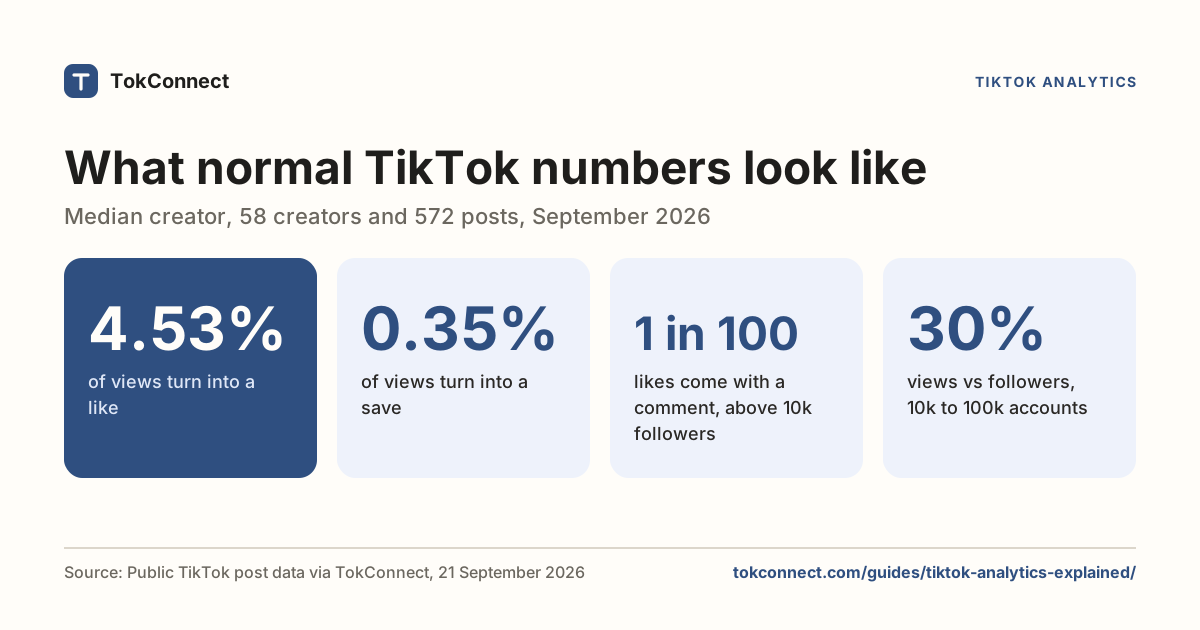
If each video is judged on its own, one account's videos should get very different view counts. They do. We took a September 2026 sample of 58 creators surfaced by TikTok search in six niches, ten recent posts each, and compared each creator's best and worst.
The typical creator's best post got about 46 times the plays of their worst. Fifty of the 58 had a gap of at least 10 times, and 10 had a gap of at least 100 times. The single best post took about 4 in 10 of all the plays across a creator's ten posts. One comedy account with 6.2 million followers ranged from 696 plays to 742,800 across ten posts. A personal finance account with about 117,000 followers ranged from 2,915 to 3 million.
| Follower tier | Creators | Median best-to-worst ratio | Creators with a gap of 10x or more | Median plays per post |
|---|---|---|---|---|
| Under 10,000 | 5 | 2.8x | 1 | 215 |
| 10,000 to 100,000 | 7 | 58.3x | 7 | 12,130 |
| 100,000 to 1 million | 17 | 40.7x | 15 | 21,800 |
| Over 1 million | 29 | 56.5x | 27 | 102,450 |
| All 58 | 58 | 45.5x | 50 | 22,075 |
Data: TikTok profile and post data, 572 posts with at least one play. Ratio is each creator's highest play count divided by their lowest over their last ten posts; the tier figure is the median creator. Re-cut, full sample.
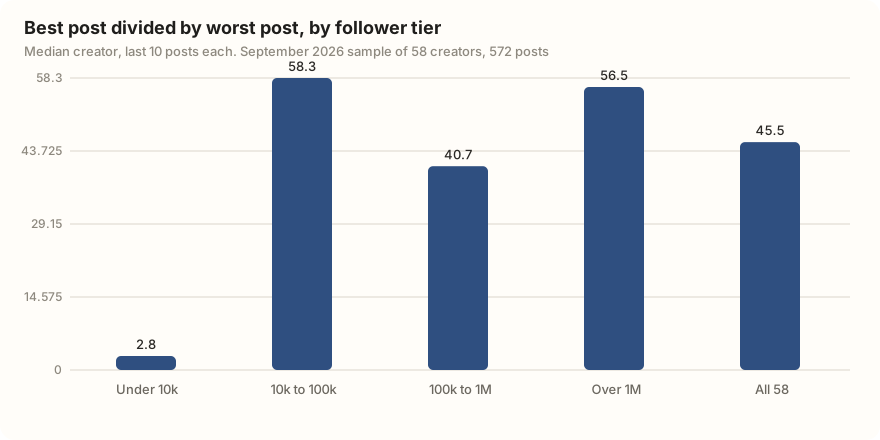
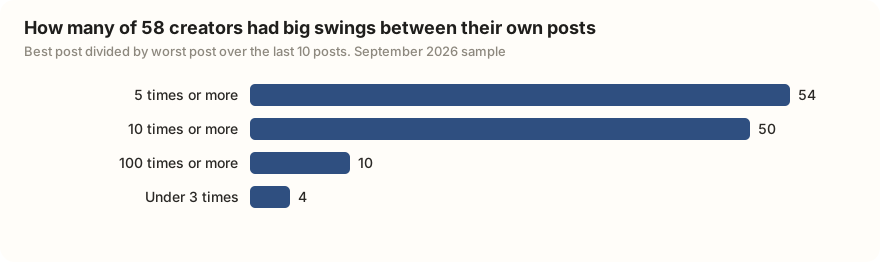
The only flat accounts were the smallest. Four creators had a gap under 3 times, and three of them had under 2,000 followers and no post over 700 plays. Once an account has any reach the swing appears, and it does not shrink as followers grow. Followers are not a floor under your views, which is what TikTok's "not a direct factor" line predicts.
So a post that gets a tenth of your usual views is not evidence of a penalty. It is the normal shape of an account. What separates your best posts from your worst is the thing worth studying. Traffic sources sit in your own TikTok Studio analytics, but the public counts are enough for a first pass.
Run the same check on your own account: TokConnect pulls your last 30 posts, ranks them by plays and shows what your top five share.
Ask me for my TikTok handle, then pull the last 30 public posts from that account and rank them by plays. For the top five and bottom five, list the plays, likes, comments, shares, saves, video length, the topic in the caption and the posting day. Tell me what the top five have in common that the bottom five do not.
The search half
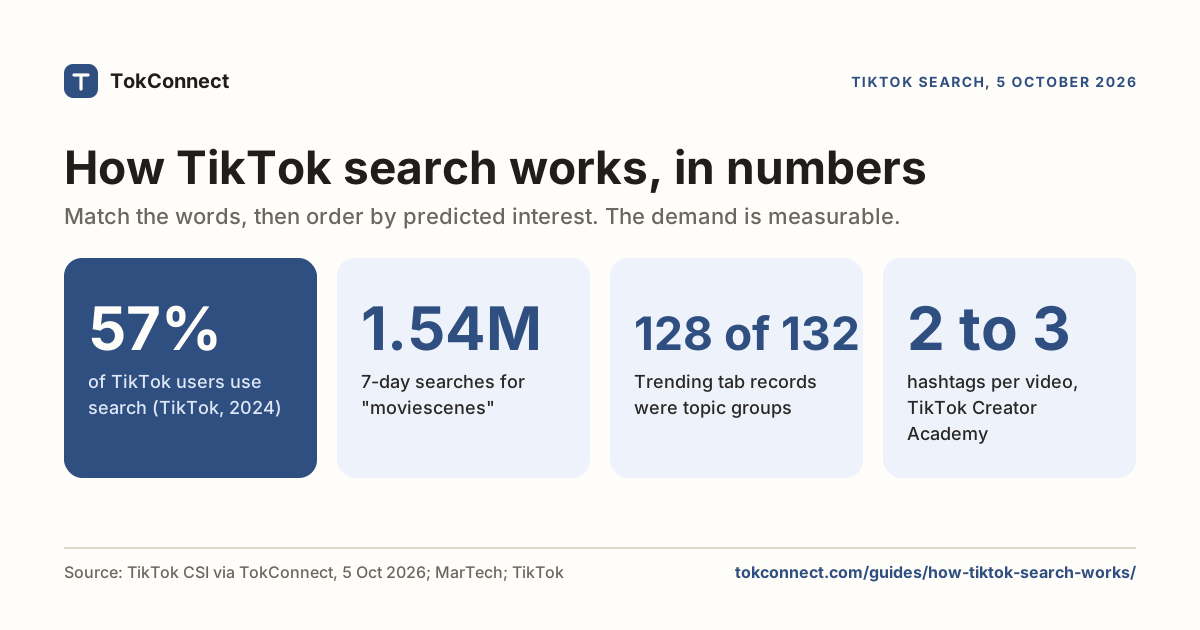
The For You feed is not the only way videos get found. TikTok said in September 2024 that 57% of its users use the search function. Adobe's February 2026 survey of 807 US consumers found 49% had used TikTok as a search engine, up from 41% in 2024, although only 4% of Gen Z said they were more likely to rely on TikTok than Google, down from 8%. TikTok has not published what share of all views comes from search.
You can see your own share. In TikTok Studio each video's detail page lists traffic sources: For You, Following, Personal profile, Search and Sound. The analytics guide explains each line. Creators report that search views keep arriving for weeks after the For You push stops, so a video with a high Search share is worth more than its first-day count suggests.
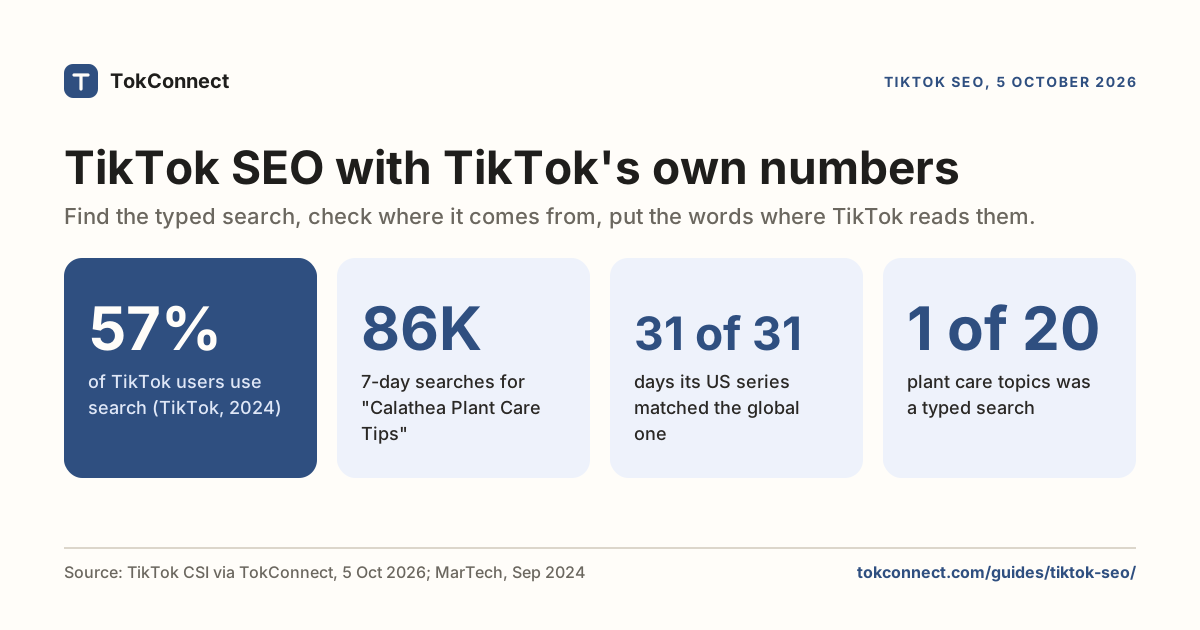
Search ranks differently: it matches your words against the caption, on-screen text, speech and sound, then orders the matches by predicted interest. That is its own subject, covered in how TikTok search works, with the practical side in TikTok SEO.
What people ask TikTok about the algorithm
Typed searches show the scale. On 5 October 2026 TikTok's topics for "tiktok algorithm" held two typed searches: "algorithms for tiktok" (266,520 searches in 7 days) and "tiktok changed algorithm" (153,953). The other 18 of 20 were TikTok topic groups that pool many searches, so we do not quote their figures.
Type "tiktok algorithm" into TikTok's search bar and the suggestions show what people worry about. Three of ten are about an update or change, one says it is broken, one asks how to reset it.
| Position | TikTok search suggestion |
|---|---|
| 1 | tiktok algorithm |
| 2 | tiktok algorithm post time |
| 3 | tiktok algorithm 2026 |
| 4 | tiktok algorithm is broken |
| 5 | tiktok algorithm views |
| 6 | tiktok algorithm 2026 update |
| 7 | tiktok algorithm change |
| 8 | tiktok algorithm explained |
| 9 | Tiktok algorithm update |
| 10 | tiktok algorithm reset |
Data: TikTok search suggestions for "tiktok algorithm". Snapshot.
Six myths, answered
It judges videos. TikTok's published position is that follower count and earlier performance are not direct factors, and the 58-creator sample shows the same account swinging from a few hundred plays to hundreds of thousands within ten posts. Almost every myth below comes from treating one weak video as a verdict on the account.
The algorithm judges your account
It does not. See the box above: it judges each video, and one weak video is not a verdict on the account.
Shadowbans
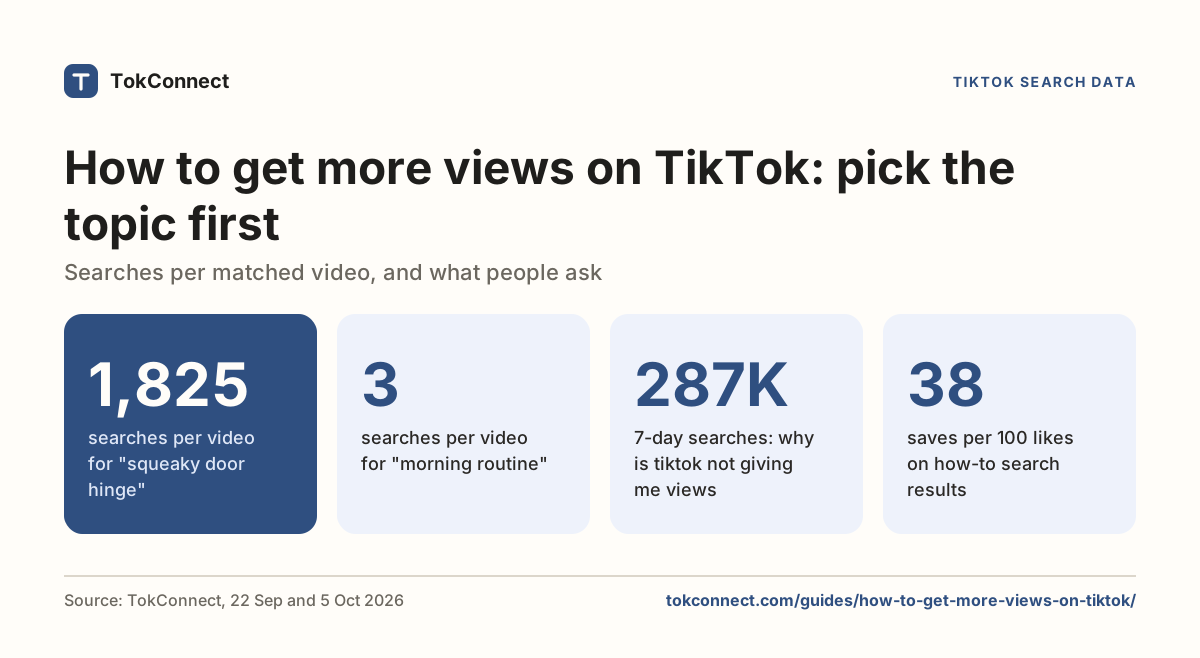
TikTok does not use the word, but it does keep videos off the For You feed under its eligibility standards, tells you on the video when that happens, and since April 2024 shows account-level restrictions under Account status, with an Account Check that audits your last 30 posts. Creators report drops with no notice, and some are real restrictions, but a drop alone proves nothing when a 46-fold swing is normal. The guide to getting more views covers how to check, and the free shadowban checker reads an account for you.
Posting time
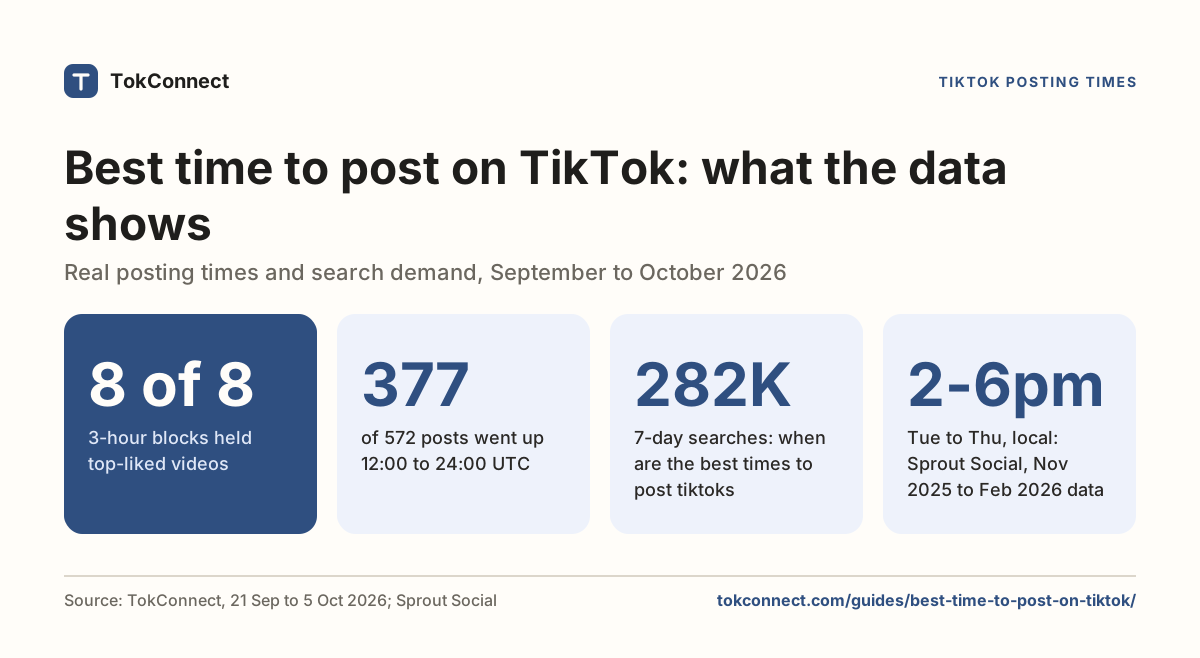
TikTok's list of signals does not include the clock, and the 572 posts in our sample went up in every three-hour block of the day. Post when your own followers are online, which TikTok Studio shows you, and see the best time to post for the numbers.
Hashtags
Hashtags are one part of "video information", the group TikTok lists second, and since August 2025 you can only add five per post. The words in your caption, on screen and in your speech do the same job with no cap; hashtags versus keywords shows the difference in numbers.
The algorithm punishes links
TikTok has published nothing that says a link lowers reach. Links in captions are not clickable in the first place, and a clickable bio link needs 1,000 followers on a personal account, so the reports of "punished" link posts are about videos that told people to leave, which viewers skip, not about a rule.
Deleting videos hurts you
TikTok has published nothing on this, and its own position that each video is judged on its own signals leaves no room for a deleted video to drag down the next one. If you are nervous, set the video to private instead; the effect on your other posts is the same, which is none that anyone has measured.
You need to warm up a new account
TikTok has published nothing about a warm-up period, and its 2020 post says a new account is not held back by having few followers. Creators are split, and the people most certain that warm-up is required tend to sell a guide to doing it.
How do you reset or retrain your For You feed?
Four tools, all from TikTok. They change what you see, not how your own posts are distributed.
- Refresh the feed. Open your profile, tap the menu in the top right, then Settings and privacy, then Content preferences, then Refresh your For You feed, and confirm. TikTok says the feed then behaves as if you had just signed up. Your followers, likes and posts stay.
- Tell it what you do not want. Press and hold any video and tap Not interested. Do it for a run of videos, not once.
- Set topic sliders. Settings and privacy, Content preferences, Manage topics. Move each topic up or down. TikTok says this changes how often a topic appears, not whether it appears at all.
- Filter words. Settings and privacy, Content preferences, Keyword filtering. Add words, phrases or hashtags you do not want to see; the smart filter also catches synonyms. TechCrunch reported the limit rising from 100 to 200 words in June 2025.
Then watch what you want more of, all the way through, for a few sessions. Finishing a video is the strongest signal TikTok has named. Steps confirmed against Metricool's guide (June 2026) and TechCrunch (June 2025); menu labels can differ slightly by region and app version.
How we got these numbers
Statements about how the feed works come only from TikTok's own published pages, labelled as such; we have no access to TikTok's code. The account data is a September 2026 sample of 58 creators surfaced by TikTok search in six niches (fitness, cooking, personal finance, small business, comedy, skincare), each creator's last 10 public posts, 572 posts with at least one play, pulled through TokConnect on 21 September 2026. The swing is each creator's highest play count divided by their lowest; tier figures are the median creator. Ten posts is a short window, and the sample reflects accounts TikTok search surfaces, not all accounts.
Search figures come from one search-count pull for "tiktok algorithm" on 5 October 2026: TikTok's 7-day worldwide search counts, typed searches only. A record counts as a TikTok topic group if its 7-day figure is 5,000,000 or more, or 1,000,000 or more with the week's first daily reading under 5% of its last, or TikTok files it as Featured Content. Data: swing re-cut, full sample, autocomplete, search topics, 5 October 2026.
Key statistics
The typical TikTok creator's best post got 45.5 times the plays of their worst over their last 10 posts, in a September 2026 sample of 58 creators and 572 posts.
50 of 58 TikTok creators in a September 2026 sample had a best post at least 10 times their worst over their last 10 posts, and 10 had a gap of at least 100 times.
All 5 statistics
TikTok's June 2020 explanation of the For You feed names three groups of ranking signals (user interactions, video information, device and account settings) and says follower count is not a direct factor; TikTok has published nothing that replaces it.
"algorithms for tiktok" was searched 266,520 times on TikTok in the 7 days to 5 October 2026, and "tiktok changed algorithm" 153,953 times.
Frequently asked questions
How does the TikTok algorithm work?
TikTok scores each video for each viewer using three groups of signals it published in 2020: what you have done on the app (watched, liked, shared, followed, commented, posted), what the video is about (caption, sound, hashtags, and now speech and on-screen text), and your device and account settings, which count for least. Strong signals such as finishing a long video weigh more than weak ones. Follower count is not a direct factor. Videos then appear to go out in stages, wider when the first viewers watch, share and save, though TikTok has not published how those stages work.
How do I reset my TikTok algorithm?
Open your profile, tap the menu, then Settings and privacy, Content preferences, Refresh your For You feed, and confirm. TikTok launched this in March 2023 and says the feed then behaves as if you had just signed up, while your followers, likes and posts stay. Follow it by pressing and holding videos you do not want and tapping Not interested, setting Manage topics sliders, and adding words to Keyword filtering. Then watch what you do want all the way through for a few sessions.
Does the TikTok algorithm favour new accounts?
TikTok has not said so. Its published position is that follower count and a creator's past performance are not direct factors, which means a new account is not held back by being new, but it is not boosted either. Creators report that early posts on a new account sometimes get an unusual number of views. In a September 2026 sample, the five accounts under 10,000 followers had a median of 215 plays a post, so "new account boost" is not something you can plan around.
Do hashtags help the TikTok algorithm?
A little. TikTok lists hashtags as part of "video information", the second of its three signal groups, alongside captions and sounds. Since August 2025 you can add at most five per post, and TikTok gave no reason for the cap. Words in your caption, on screen and spoken aloud do the same job of telling TikTok what the video is about, with no limit, and they also help the video appear in search. Use three to five relevant hashtags and spend your effort on the words.
Is there a TikTok shadowban?
Not under that name. TikTok publishes For You feed Eligibility Standards that keep some videos off the feed, tells you on the video when that happens, and since April 2024 shows account-level restrictions under Account status, with an Account Check that reviews your last 30 posts. So restrictions exist and are visible. A sudden drop in views on one post is not one of them: in a September 2026 sample of 58 creators, the typical creator's best post got 46 times the plays of their worst.
Does posting time affect the algorithm?
TikTok's published list of signals does not include when you post. Posting time matters only in the ordinary way: if your followers are awake, the first viewers arrive sooner. In a sample of 572 posts from 58 creators, videos went up in every three-hour block of the day. Post when TikTok Studio shows your own followers are online, hold the slot for two weeks, and judge by first-hour views.
Sources and data
- How TikTok recommends videos #ForYou (TikTok Newsroom, June 2020)
- Introducing a way to refresh your For You feed (TikTok Newsroom, March 2023)
- For You feed Eligibility Standards (TikTok Community Guidelines)
- Making your feed For You (TikTok Safety Center)
- How the TikTok Algorithm Works in 2026 (Sprout Social, 6 February 2026)
- How the TikTok algorithm works in 2026 (Hootsuite, 1 June 2026)
- TikTok's new feature lets you refresh your For You feed (TechCrunch, 16 March 2023)
- TikTok will block users from For You feed for problematic content; Account Check (Variety, April 2024)
- TikTok rolls out AI-powered Smart Keyword Filters (TechCrunch, 3 June 2025)
- TikTok implements five hashtag limit per post (Social Media Today, 17 August 2025)
- TikTok Algorithm Guide: How to Change or Reset Your FYP (Metricool, 12 June 2026)
- ByteDance signs deal for TikTok US joint venture; algorithm to be retrained on US data (Music Business Worldwide, 22 December 2025)
- TikTok's algorithm to be licensed to US joint venture (PBS NewsHour, 23 September 2025)
- The deal to secure TikTok's future in the US has closed (CNN Business, 22 January 2026)
- What makes TikTok tick: the leaked algorithm document (DeepLearning.AI, December 2021)
- Inside TikTok's Dangerously Addictive Algorithm, the Wall Street Journal bot investigation (Online Journalism Awards)
- The 2026 TikTok Algorithm Explained (SocialPilot, August 2026)
- TikTok Search Ads Campaign launches in US, with TikTok's 57% search-usage figure (MarTech, September 2024)
- Using TikTok as a search engine (Adobe Express, 17 February 2026)
- Post-to-post play spread in the September 2026 creator sample (snapshot)
- 58-creator benchmark sample, 21 September 2026 (snapshot)
- TikTok search suggestions for "tiktok algorithm", 22 September 2026 (snapshot)
- TikTok search topics for "tiktok algorithm", 5 October 2026 (snapshot)