 tokconnect
Claude Desktop supports remote MCP connectors through Settings → Connectors. Anthropic documents URL and OAuth setup for that path. TokConnect accepts a provisioned bearer key at its Streamable HTTP endpoint. A local stdio bridge supplies a bearer-header option; the remote connector UI remains a separate path whose static-header support is not established by Anthropic's documentation.
Choose a supported path
Use a client that documents a static authorization header if you want to start research with a TokConnect key today. Claude Code, Codex, Cursor, and Gemini CLI each have a configuration path for that header.
Use Claude Desktop's connector screen when TokConnect provides an OAuth-enabled remote connector. Entering the MCP URL in that screen without a compatible authentication flow will not convert a bearer key into an OAuth login. A local configuration file also will not make Claude Desktop connect directly to a remote server: Anthropic documents that remote servers configured in claude_desktop_config.json are not used by the remote connector feature.
Decide between Connector and bridge
| Path | Who makes the network connection | Credential model documented here |
|---|---|---|
| Settings → Connectors | Anthropic's remote connector service | Anthropic documents URL entry and OAuth authorization. Its help article does not establish a field for a static bearer header. |
| Local stdio bridge | A process that Claude Desktop launches on your Mac | The bridge can receive a header argument and make the remote HTTP request. You operate, review, and update that process. |
This distinction explains why copying a key into a local file does not change what the Connector screen can authorize. It does not prove that a bearer-based connector is impossible. If TokConnect later publishes a connector-specific OAuth path or Anthropic adds documented custom-header support, use the supported connector flow and retire the bridge.
Keep the auth method with the client
TokConnect uses:
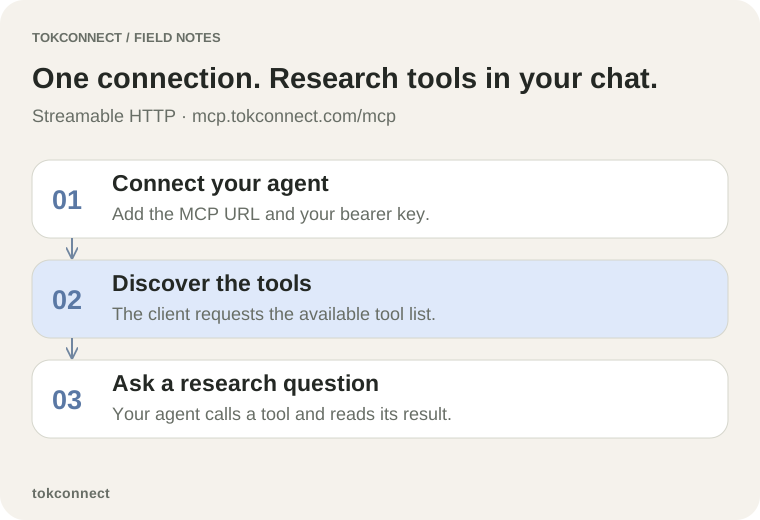
Endpoint: https://mcp.tokconnect.com/mcp
Header:   Authorization: Bearer YOUR_TOKCONNECT_KEY
Transport: Streamable HTTP
Claude's remote connector service runs outside your desktop network. The Claude help center states that this connection originates from Anthropic's infrastructure, even in the Desktop app. Your local shell environment and a bearer key saved on your Mac do not flow into that hosted connector.
Before adding any bridge, confirm that Node and npx are available to the Desktop application, not just to an interactive terminal. A bridge started by Desktop may have a different environment. The shown env block passes the token to that child process; replace the placeholder using the secret mechanism you trust and keep the completed file private. The package documentation, not Claude's connector documentation, is the source for this bridge configuration.
Evaluate a local bridge with care
A stdio-to-remote bridge can give an older local-MCP client a process it can launch, while the bridge sends the HTTP header to TokConnect. The mcp-remote package documentation describes this pattern and supports --header. Treat it as third-party software: review its release and test it with a disposable key before placing it in a regular workflow. The example pins the version used for the isolated argument check described below.
{
  "mcpServers": {
    "tokconnect": {
      "command": "npx",
      "args": [
        "-y",
        "mcp-remote@0.14.2",
        "https://mcp.tokconnect.com/mcp",
        "--header",
        "Authorization:Bearer ${TOKCONNECT_TOKEN}"
      ],
      "env": {
        "TOKCONNECT_TOKEN": "YOUR_TOKCONNECT_KEY"
      }
    }
  }
}
This is a bridge configuration, not a TokConnect-supported installation or a Claude Desktop test. The pinned package documents the static-header bridge pattern. A successful authenticated Claude Desktop connection has not been verified for this guide. The package documents the no-space header form for clients that split argument values containing spaces.
Verify the result or switch clients
Put the bridge entry in ~/Library/Application Support/Claude/claude_desktop_config.json on macOS, then restart Claude Desktop. The mcp-remote package documents that configuration location and header form. Ask for a small read-only request:
Call list_languages and return each language key. Stop after the tool response.
The editorial MCP environment returned status code 0 and 12 keys, including en, in the protocol fixture. No live authenticated Claude Desktop bridge test ran in this review.
A successful first response should contain language codes rather than a narrative answer. Record the codes you need, then use a language value such as en in a later topic request. This makes the first call a read-only connection check with a result you can inspect. It also avoids consuming effort on a large video search before you know whether the bridge can reach the server.
If Claude Desktop cannot list the tools, stop at the bridge boundary: check the bridge's own logs, the endpoint, and its header handling. A 401 points to the bearer credential. An empty topic list points to the query response. The troubleshooting guide separates those two outcomes.
Recover or remove the bridge
| What you see | What to inspect | Safe next step |
|---|---|---|
| No server after restart | The JSON syntax, command, arguments, and Desktop's ability to find npx. | Fix one field, restart Desktop, and inspect the MCP tool list again. |
| Bridge starts but connection fails | The endpoint and bridge diagnostic output. | Check that the URL remains https://mcp.tokconnect.com/mcp; do not replace it with an inbound local server URL. |
| 401 or unauthorized | The token source and Authorization:Bearer argument. | Replace the key, restart Desktop, and repeat list_languages. |
| You no longer want the bridge | The tokconnect block in the Desktop configuration file. | Remove that block, save valid JSON, and restart Desktop. |
Anthropic's custom connector guide remains the source for the product's supported remote path. The local bridge remains a user-managed compatibility layer.
Read the TikTok MCP guide before you choose a connection path. A working client can use the content-gap workflow for its next read-only task.