 tokconnect
YouTube Shorts vs TikTok comes down to one trade: TikTok gets a new video in front of strangers faster, while YouTube pays more per view and keeps videos findable for years. Both run a full-screen feed of short vertical video that mostly reaches people who do not follow you, so a small account can travel past its follower count on either app. This page compares the two on audience, reach, search, money and repurposing, with 2025 and 2026 figures you can check.
The short version: pick TikTok to get discovered and to sell on impulse, pick YouTube to earn more per view and to build a library that keeps working. Many creators post the same clip to both. If you do, strip the watermark first, because YouTube treats obviously recycled video as lower quality.
Who is on each app
Both apps are huge, and YouTube is the bigger. Its ads reached about 2.53 billion people in January 2025, against roughly 1.59 billion adults for TikTok, per DataReportal's January 2025 figures. In the US the gap is wider: 84% of adults use YouTube and 37% use TikTok, per Pew Research Center's Americans' Social Media Use 2025 (November 2025). Among teens they are closer: nearly all US teens use YouTube and about six in ten use TikTok, per Pew's teens report (December 2025).
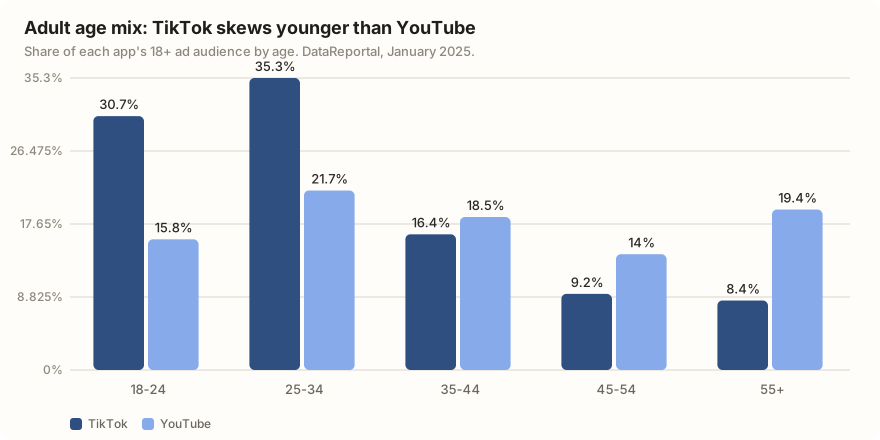
Age is where they part. The chart above shows TikTok packed into the under-35s, while YouTube reaches deeper into older adults: about 19 in 100 of YouTube's adult audience is 55 or older, against about 8 on TikTok. Want people over 45? YouTube has more. If your buyers are 18 to 34, both apps are full of them.
| Measure | TikTok | YouTube |
|---|---|---|
| Adults its ads reach | 1.59 billion | 2.53 billion |
| US adults who use it | 37% | 84% |
| US teens (13-17) who use it | about 60% | about 90% |
| Share of adult audience aged 18-34 | about 66% | about 38% |
| Share of adult audience 55+ | about 8% | about 19% |
Ad reach and age bands: DataReportal, January 2025. US adult and teen use: Pew Research Center, 2025. Snapshot of our own data.
How a new video gets seen
This is where the two apps feel alike but work differently. Open TikTok and you land on the For You feed of recommended videos. TikTok has said it recommends a video to non-followers based on how the video performs, not on your follower count, so a first post can reach strangers the same day. YouTube's Shorts feed works the same way, showing Shorts to non-subscribers on their merits. The difference is what surrounds each feed. TikTok is almost all For You; YouTube wraps its Shorts feed in a home page, a search box people use on purpose, a subscriptions tab and suggested videos, so a Short can pull a viewer into that wider system.
Our own numbers show what reaching past your followers looks like on TikTok. From a September 2026 sample of 58 creators surfaced by TikTok search in six niches, we divided each creator's median views per post by their follower count.
Accounts under 10,000 followers had a median of about one play per follower, meaning the For You feed carried the video past their whole following. The multiple falls as accounts grow: about 0.30 plays per follower at 10,000 to 100,000, 0.07 at 100,000 to 1 million, and 0.035 above a million, because a giant following is hard to beat with views. YouTube publishes no matching plays-per-subscriber figure for Shorts, and no reputable source computes one per channel, so we are not inventing one. Read the TikTok figures as evidence that small accounts reach beyond their followers, not as a head-to-head with Shorts.
Search: a new tool versus a mature engine
People use both apps to search, which is one of TikTok's clearest short-term wins and one of YouTube's oldest strengths. TikTok publishes search demand through Creator Search Insights, a free tool it launched in 2024 that lists what people type into TikTok search and flags topics with few videos answering them, and it treats your spoken words and caption text as searchable. Our TikTok search statistics page collects the figures, and how TikTok search works explains the ranking signals.
YouTube has run a search engine for two decades. Its Studio Research tab shows what viewers search on YouTube, its Analytics reports the terms that bring people to your videos, and Google Trends has a YouTube search mode. Both hand creators keyword data, but YouTube's search is older, larger and tied to Google, and a well-titled video can keep collecting search views for years after a TikTok has left the feed. If lasting search traffic is your plan, YouTube is built for it; if you want this week's demand answered fast, TikTok's tool is sharper.
Money: a rewards pool versus an ad-revenue share
This is the honest heart of the comparison, and it is not a straight who-pays-more: the two apps pay in structurally different ways. TikTok runs the Creator Rewards Program, an open payout for videos over one minute. To join you must be 18 or older with at least 10,000 followers and 100,000 video views in the last 30 days, per TikTok's program terms. It pays from a TikTok rewards pool based on qualified views and quality, not from a share of the ads on your video, and TikTok does not publish a rate. YouTube's Partner Program asks for 1,000 subscribers plus either 4,000 public watch hours in a year or 10 million Shorts views in 90 days. Once you are in, Shorts pay an actual ad-revenue share: YouTube pools the Shorts-feed ad money and, per its Shorts monetization policy, creators keep 45% of their allocated share. That watch-hour bar rises in early 2027, so check the current number.
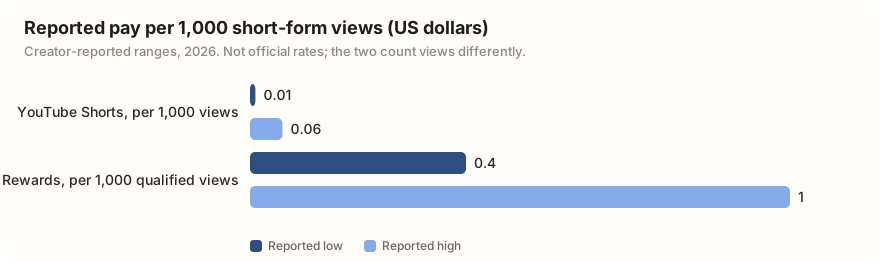
Creator reports bear out the split. YouTube Shorts pay very little on their own, around 1 to 6 cents per 1,000 views in 2026 reports, because the Shorts pool is small and spread thin. TikTok Creator Rewards are reported at about $0.40 to $1.00 per 1,000 qualified views, but a qualified view is a stricter unit than a raw play, so the chart above is not a like-for-like rate. The figure that dwarfs both is YouTube long-form, with reported RPMs from about $1 to $10 or more per 1,000 views. That is why many creators treat Shorts as a way to get found and long videos as the way to get paid. Our make money on TikTok guide covers the math. All these rates are creator-reported; neither company publishes an official figure.
Long-form: the crossover YouTube is built for
Short video is a front door on both apps, but only YouTube has a full house behind it. A Short can send a new viewer to your channel, where a subscribe button and longer videos wait. YouTube tells creators that Shorts help new people find them, and that Shorts and long-form recommendations run as separate systems, so posting Shorts does not hurt your long videos. That crossover, from a 30-second clip to a long video earning a full ad-revenue share, is YouTube's real advantage.
TikTok is closing the gap on length, with uploads now up to 60 minutes, far past the old 60-second cap, and Creator Rewards pays only on videos over a minute. But TikTok has no long-form ad-revenue share to match YouTube's, and its longer videos live in the same feed rather than a separate library people browse. If your plan is to turn viewers into subscribers who watch longer content, YouTube gives them somewhere to go.
TikTok vs YouTube Shorts: the quick comparison
| Where it counts | TikTok | YouTube Shorts |
|---|---|---|
| Default experience | For You feed of recommended video | Shorts feed inside a home, search and subscriptions app |
| New-account reach | High: For You pushes to strangers day one | High: Shorts feed shows non-subscribers too |
| Small-account reach (our data) | ~1.0 play per follower under 10k | No public per-channel figure |
| Audience age | Skews under 35 | Wider; strong over 45 |
| Search demand tool | Creator Search Insights (2024) | Studio Research, Analytics terms, Google Trends |
| How long videos stay findable | Weeks in the feed; search extends it | Months to years via search and suggested |
| Payout model | Rewards pool, not an ad-revenue share | 45% share of the Shorts ad pool |
| Payout entry | 10k followers, 100k views/30 days, videos over 1 min | 1,000 subs + 4,000 watch hours or 10M Shorts views/90 days |
| Reported short-form pay | ~$0.40-$1.00 per 1,000 qualified views | ~$0.01-$0.06 per 1,000 views |
| Long-form earning | Videos over 1 min via Rewards; no ad-share | Full 55% ad-revenue share on long videos |
| In-app shopping | TikTok Shop, buy without leaving | Shopping via product tags and affiliate links |
| Recycled clips | Downranks obvious reposts | Reused-content policy can limit reach and pay |
Programs and 45% share: YouTube Help and TikTok program terms, 2025-2026. RPM figures are creator-reported 2026 data (Mediacube, AIR Media-Tech, Uppbeat); neither company publishes an official rate. Reach data: our September 2026 sample.
Repurposing and watermarks
The easy win is to shoot once and post everywhere, and it works if you do it cleanly. The trap is the watermark: a saved TikTok has its logo and username burned into the file, and YouTube's reused-content and inauthentic-content rules treat clearly recycled video as lower quality.
Uploading a TikTok-watermarked clip to YouTube Shorts marks it as recycled, and YouTube's reused-content policy can hold back its reach and its ad-revenue eligibility. Export a clean copy without the watermark, or use TikTok's own save-without-watermark option where offered, before you post to Shorts. The same rule runs in reverse: a YouTube or Instagram watermark on a TikTok looks just as recycled.
What creators report
Creators' posts are reports, not proof, but the pattern is consistent. Across r/NewTubers, threads comparing the two describe TikTok bringing faster raw views from strangers, while YouTube brings fewer views that are worth more and keep coming in. The gap can be stark: in r/youtubers, a May 2026 thread titled "Same video: 10M views on TikTok/IG, 2k on YouTube" describes a clip going huge on TikTok and Instagram while barely moving on Shorts. It fits the structure above: TikTok's feed rewards velocity, and a new channel has to earn its way into YouTube's recommendations. The flip side, reported just as often: those YouTube views tend to subscribe and pay.
Which one to pick
Pick TikTok if you are starting from zero and want strangers to find you fast, your audience is under 35, you sell something people buy on impulse, or you want to see and answer this week's search demand. The For You feed and Creator Search Insights are made for that.
Pick YouTube Shorts if you want each view to be worth more, you are building toward long videos and subscribers, your audience skews older, or you want videos that keep earning search views for years. The 45% Shorts ad-share plus a full share on long-form is the stronger money over time.
Do both if you can make one vertical clip serve two apps without looking recycled. Shoot clean, strip any watermark, lead with a hook, and let TikTok find your audience while YouTube banks the long-term views; the same clip usually serves Instagram Reels too. Most creators who win use TikTok to get discovered and YouTube to get paid.
Using TokConnect, search TikTok for topics in my niche and list each topic's 7-day search volume and video count, and flag any content gaps. For the three highest-demand gaps, draft one 45-second vertical video idea I can post to both TikTok and YouTube Shorts, each with a spoken hook, an on-screen title using the topic's exact wording, and a caption with no more than five hashtags.
Works in Claude, ChatGPT, Cursor and Gemini once TokConnect is connected. Get a free key (100 credits, no card) or see the setup guides.
Frequently asked questions
Is YouTube Shorts or TikTok better in 2026?
Neither wins for everyone. TikTok is better for getting found fast, for audiences under 35, and for selling on impulse, because the For You feed pushes videos to strangers and Creator Search Insights shows live demand. YouTube Shorts is better if you want each view to be worth more, you are building toward long videos and subscribers, or you want videos that keep earning search views for years. Many creators use TikTok to get discovered and YouTube to get paid.
Which pays more, YouTube Shorts or TikTok?
It depends on how you count. On raw short-form views, TikTok Creator Rewards are reported at about $0.40 to $1.00 per 1,000 qualified views, while YouTube Shorts are reported near $0.01 to $0.06 per 1,000 views, but a TikTok qualified view is a stricter unit than a raw play. The bigger picture favours YouTube, because Shorts pay a 45% share of real ad revenue and YouTube long-form videos earn far more, around $1 to $10 or more per 1,000 views. All these rates are creator-reported; neither company publishes an official figure.
Which reaches new people faster, TikTok or YouTube Shorts?
Usually TikTok, especially for a brand new account. Its For You feed is built to show a video to non-followers on day one based on how the video performs. YouTube's Shorts feed also reaches non-subscribers, but a channel with little history often takes longer to earn recommendations. In our September 2026 sample, TikTok accounts under 10,000 followers got a median of about one play per follower; YouTube publishes no comparable per-channel figure for Shorts.
Can I post the same video on TikTok and YouTube Shorts?
Yes, but export a clean copy first. A finished TikTok has the app's logo and username burned into the file, and YouTube's reused-content and inauthentic-content rules treat obviously recycled clips as lower quality, which can hold back reach and ad-revenue eligibility. Use a version with no watermark, or TikTok's save-without-watermark option, before you upload to Shorts. The same applies in reverse for a YouTube or Instagram watermark on TikTok.
Is TikTok or YouTube better for a small creator starting out?
TikTok tends to reward beginners with faster reach, because the For You feed judges each video on its own performance rather than your follower count, and Creator Search Insights points you at topics with few videos answering them. YouTube grows more slowly at first but builds a library that keeps earning search views and can turn viewers into subscribers for your long videos. If you want quick signal on what works, start on TikTok; if you are playing the long game, start building on YouTube too.
Do YouTube Shorts help my long videos?
YouTube has told creators that Shorts help new people discover a channel and that Shorts and long-form recommendations run as separate systems, so posting Shorts does not hurt your long videos. A Short can send a viewer to your channel, where a subscribe button and longer videos wait, and long-form is where YouTube pays a full ad-revenue share. That crossover from short clip to long video is YouTube's main advantage over TikTok.
Sources and data
- YouTube Users, Stats, Data & Trends (DataReportal, Jan 2025)
- TikTok Users, Stats, Data & Trends (DataReportal, Jan 2025)
- Americans' Social Media Use 2025 (Pew Research Center, Nov 2025)
- Teens, Social Media and AI Chatbots 2025 (Pew Research Center, Dec 2025)
- YouTube Shorts monetization policies, 45% share (YouTube Help)
- YouTube Partner Program eligibility (YouTube Help)
- YouTube channel monetization / reused content policy (YouTube Help)
- Creator Rewards Program terms, US (TikTok)
- Creator Search Insights (TikTok Newsroom, 2024)
- YouTube Shorts RPM in 2026, creator-reported (Mediacube)
- Shorts vs TikTok Creator Rewards pay, creator-reported (AIR Media-Tech)
- Creator reach sample, six niches, September 2026 (snapshot)
- Autocomplete and derived figures for this page (snapshot)