 tokconnect
When you search on TikTok, the app runs your phrase against everything it has indexed and returns a set of tabs: Top, Videos, Users, Sounds, LIVE, Shop and Places. Top is the default and mixes formats. Each tab is ranked by how relevant TikTok thinks the result is to the phrase and to you, which means two people searching the same words do not get the same list.
So how does TikTok search work in practice? It behaves like a search engine with a recommendation engine bolted to it. Relevance decides what is eligible; your history and the video's performance decide the order. TikTok's own figure, given when it launched Search Ads in September 2024, is that 57% of users use the app's search function.
This page covers what happens when you search, what TikTok has published about ranking, where the suggested searches under videos come from, and how much demand is actually flowing through search, using numbers from TikTok's own creator tool.
What happens when you search
TikTok's help centre keeps the instructions short: tap Search at the top, type what you are looking for, tap Search, and the most relevant results come first. What it does not spell out is the shape of the results page.
| Tab | What it returns | Useful for |
|---|---|---|
| Top | A mixed set: videos, accounts, sometimes a product or a place | Seeing what TikTok thinks the query means |
| Videos | Video results only, with filters for sort order and date posted | Checking how much competition a keyword has |
| Users | Accounts whose name, handle or bio matches | Finding creators in a niche |
| Sounds | Audio with title, artist and length | Tracking a sound before it peaks |
| LIVE | Live streams matching the phrase right now | Real-time topics |
| Shop | Product listings from TikTok Shop | Commercial intent behind a query |
| Places | Location results and videos tagged there | Local and travel searches |
Under the More options button you get filters: sort by relevance or most liked, and narrow by date posted. The date filter is the one creators underuse. If the top results for your keyword are all three years old, that is an opening.
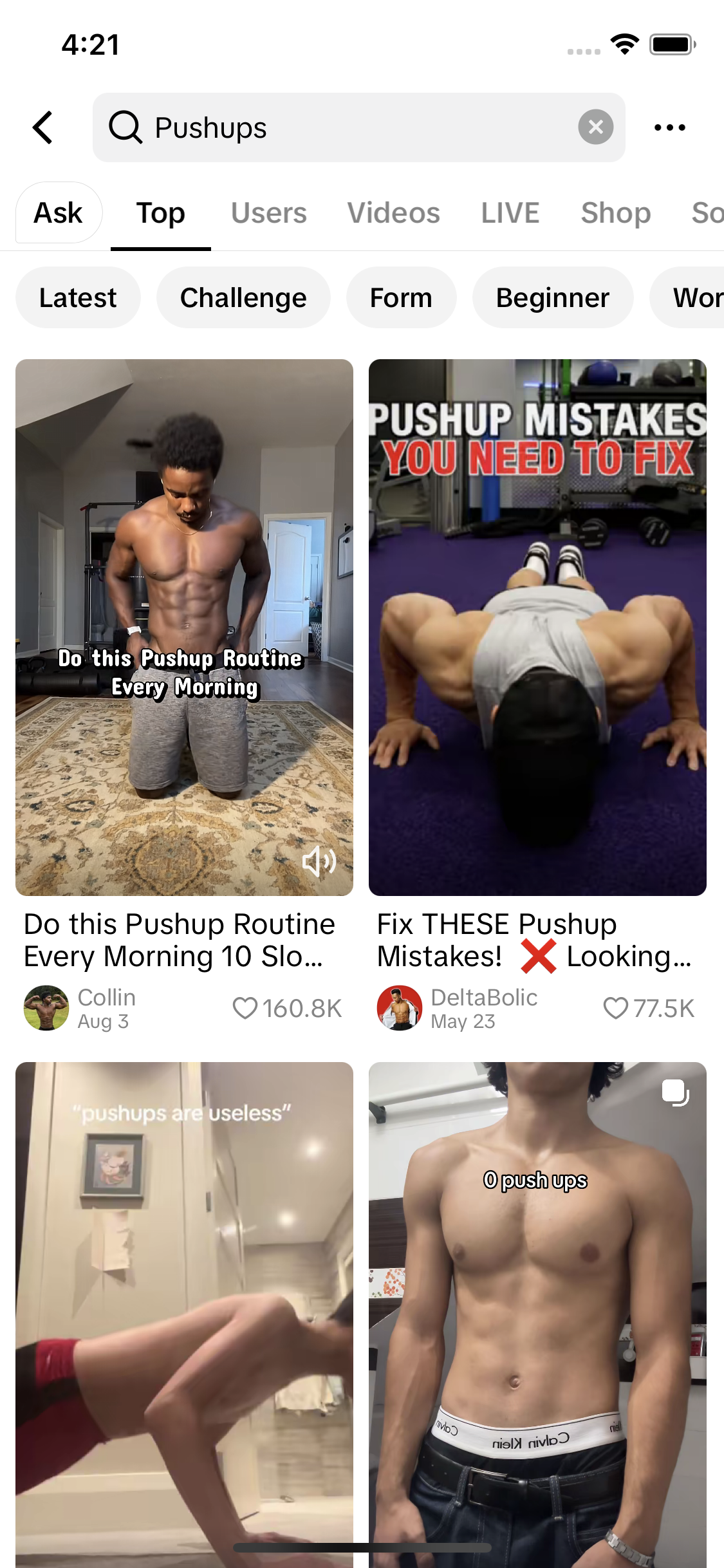
What the TikTok search engine actually ranks
TikTok has never published a search ranking document. What it has published is how its recommender systems work, and search sits on the same machinery: each system selects from a large collection of eligible content and ranks it on a prediction of how likely you are to be interested.
Two layers, then. The first is matching. TikTok reads your caption, the on-screen text, the words you say, your hashtags and your sound to work out what a video is about. A video that never states its subject in any of those places is hard to match, however good it is.
The second is ordering. Among videos that match, TikTok favours the ones it predicts you will watch, which is driven by engagement on the video and by your own history. This is why the personalised search setting exists: TikTok states that turning it off gives you non-personalised search results and recommendations, and also changes your suggested searches.
There is no keyword density, no meta description and no backlink equivalent. Repeating a phrase eight times in a caption does not help, and no hashtag ranks a video for a topic it does not cover. Matching is about being clearly about one thing.
The search bar under a video
While you watch, a small keyword box sometimes appears near the caption. Tap it and TikTok runs that search. It is generated from what TikTok has understood the video to be about, and it is the closest thing creators get to a free diagnostic.
If the chip under your cooking video says something sensible about the dish, TikTok has filed the video correctly and it can surface for those searches. If the chip is generic or unrelated, the video has not been understood, and no amount of hashtags will fix that. The search suggestions guide covers the other places suggestions appear and how to mine them.
How much demand is flowing through search
TikTok publishes real search counts in one place: Creator Search Insights, in the app and at tiktok.com/csi. Every topic there carries a search-popularity figure for the last seven days. These five came off the trending list on 19 September 2026.
| Trending topic | 7-day searches | Videos matched | Category |
|---|---|---|---|
| cristiano ronaldo merchandise and media | 22,326,965 | 5,546 | Sports |
| best ways to boost minecraft view | 21,725,814 | 0 | Gaming |
| disney cruise kids club room | 11,066,978 | 0 | Tourism |
| pink mist jumpers | 10,711,385 | 0 | Fashion |
| different types of dinosaurs | 4,700,189 | 0 | Science |
Data: TikTok Creator Search Insights via TokConnect, pulled 19 September 2026. Open the snapshot. The live list is on the trends hub.
Two things to take from that table. The scale is weekly, not monthly, so eleven million searches for a Disney cruise room is a week of demand. And four of those five have no videos matched to the topic, which is what TikTok flags as a content gap. Demand arriving at a search with nothing to answer it is the cleanest opportunity on the platform.
How TikTok search differs from Google
The mechanics rhyme and the behaviour does not.
- Queries are longer and more conversational. People type "gym for beginners day 1", not "beginner gym".
- Results are personalised by default. Google personalises lightly; TikTok's ranking runs on a prediction of what you specifically will watch.
- Freshness counts for more. A three-year-old blog post can hold a Google ranking for years. On TikTok the same query surfaces new videos constantly.
- The answer is a demonstration. Searchers want to watch the thing happen, which is why "show me" queries outperform explainers.
- There is no click. Success is a watch, not a visit, so the whole answer has to be in the video.
The figures on how many people search TikTok instead of Google, and what they search for, are collected on our TikTok search statistics page.
What it means for creators
Four things follow from all of the above, and they are cheap to do.
- Say the phrase. Put your target wording in the caption, in the on-screen text and out loud in the first few seconds. That is the matching layer, and it is the part you control.
- Pick a topic with demand and few videos. Search your niche in Creator Search Insights and sort by searches against video count, not by search count alone.
- Check the chip. A day after posting, look at the keyword box under your own video. If it is wrong, your next video needs to be clearer, not louder.
- Use the date filter on your competitors. Search your keyword, filter to the last six months, and see whether anyone is actually serving it now.
For the keyword "beginner sourdough", show me the TikTok video results and the matching Creator Search Insights topics. For each topic give the 7-day search volume, the popularity score and the video count, then tell me which one has the most searches per existing video.
The rest of the checklist, including captions, on-screen text and what hashtags are still worth doing, is in the TikTok SEO guide.
Frequently asked questions
Does a person know if you search them on TikTok?
No. TikTok does not tell anyone that you searched their name or opened their profile, and there is no viewer list for profiles. The only things a creator sees are the aggregate numbers in their own analytics, such as how many people found a video through search, never who.
How do TikTok searches work?
TikTok matches your phrase against what it has understood each video to be about, drawn from the caption, on-screen text, spoken words, hashtags and sound. It then orders the matching results by how likely it predicts you are to watch them, which is why two people searching the same phrase see different lists.
What does the search bar at the bottom of my TikTok video mean?
It is a suggested search that TikTok generated from what it thinks the video is about. Tapping it runs that search. For creators it doubles as a free check: if the phrase makes sense for your video, TikTok has filed it correctly and it can appear for those searches.
Is TikTok a search engine?
It works like one for the queries people bring to it: a search bar, an index built from video content, ranked results and paid results alongside them. It differs in that ranking is personalised by default, freshness counts for more, and the answer is a video to watch rather than a link to click.