 tokconnect
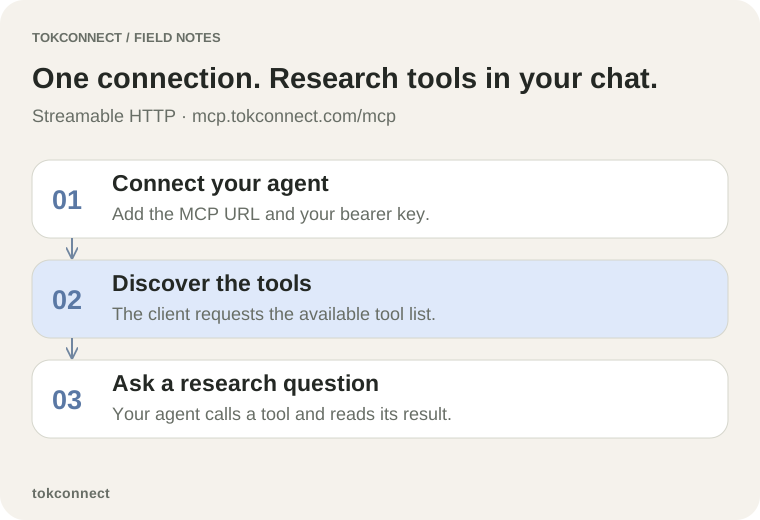
Claude Code can connect to a remote MCP server over HTTP. TokConnect exposes its research tools at https://mcp.tokconnect.com/mcp; the server expects your provisioned key in an Authorization: Bearer header. Sign in at TokConnect with Google and copy the key before you begin.
Add the server
Anthropic documents claude mcp add --transport http for a remote HTTP server and accepts custom headers. Run this in a terminal where Claude Code is installed. Use a personal configuration unless a team has agreed on a project-level MCP file.
claude mcp add --transport http tokconnect https://mcp.tokconnect.com/mcp \
  --header "Authorization: Bearer YOUR_TOKCONNECT_KEY"
The command stores a local MCP entry. Claude Code supports local, project, and user scopes. A project scope writes .mcp.json, which a teammate may commit, so do not put a live token in that file. Anthropic documents environment-variable expansion in MCP URLs and headers for shared configurations.
Pick a scope before you add it
| Scope | Where it lives | When it fits |
|---|---|---|
| Local | Your local Claude configuration | A personal experiment or a key that must stay on one machine. |
| User | Your user-level Claude configuration | Research you use across several repositories. Add --scope user to the command when that is the intended scope. |
| Project | .mcp.json in the repository | A shared server definition. Keep only the environment-variable placeholder in the file and let every contributor supply their own token. |
Start with local or user scope if you are learning the tools. A project entry can cause Claude Code to request approval because project configuration can affect everyone who opens the repository. Read the endpoint and header placeholder in that approval dialog. The server name, URL, and token variable should match this guide before you continue.
Use a shared project file without sharing a key
Save the server definition below as .mcp.json only if your project needs the same research capability. Each user must set TOKCONNECT_TOKEN in the environment that launches Claude Code.
{
  "mcpServers": {
    "tokconnect": {
      "type": "http",
      "url": "https://mcp.tokconnect.com/mcp",
      "headers": {
        "Authorization": "Bearer ${TOKCONNECT_TOKEN}"
      }
    }
  }
}
For a one-session shell check on macOS or Linux, enter the key without placing its value in the command line:
read -s "TOKCONNECT_TOKEN?TokConnect key: "
export TOKCONNECT_TOKEN
printf '\n'
claude
This leaves the value out of shell history for that session. Anthropic documents the MCP environment reference but does not prescribe an OS-specific persistent secret setup on its MCP page. For a persistent setup, use the secret-management or shell-startup method your organization already approves, and verify that it applies to the process that launches Claude Code.
Confirm that Claude Code found the tools
Start or restart a Claude Code session, type /mcp, and inspect the tokconnect server. The connection should expose research tools such as keyword_research, search_videos, video_comments, and search_users. The exact list can change as TokConnect updates its server.
Call search_suggestions with keyword “walking pad” and count 3. Return the suggestion text and count without proposing a content brief.
A configured editorial MCP environment completed that call on September 18, 2026. It returned count 3 and “walking pad,” “walking pad treadmill,” and “walking pad exercise at home.” See the protocol fixture. That fixture proves the tool response, not a Claude Code connection.
The command follows Claude Code’s documented HTTP configuration. The linked response fixture was collected through the editorial MCP environment, not an authenticated Claude Code session. Verify tool discovery in your own client before beginning a research run. One MCP tool call uses one TokConnect credit; a compound tool can make several upstream requests while remaining one MCP call.
After Claude returns the three suggestions, choose one phrase and move to keyword research. That is a useful boundary: suggestions broaden a wording choice, while keyword research supplies the fields used to decide whether the phrase deserves a brief. Do not ask the client to infer popularity from the suggestion order.
Fix connection errors
| Symptom | Check | Next action |
|---|---|---|
tokconnect does not appear in /mcp | Run claude mcp list. | Add the server again, then start a fresh session. |
| 401 or unauthorized response | Check the header name, the Bearer prefix, and the key source. | Copy a fresh provisioned key from TokConnect and relaunch Claude Code from the shell that has the environment variable. |
| Tools appear but the request has no matches | The MCP connection succeeded; the query returned no usable result. | Try a shorter phrase, call search_suggestions, or state a language filter. Do not treat an empty result as an authentication failure. |
| A project server asks for approval | Claude Code protects project-scoped MCP configuration. | Review the server URL and header placeholder, then approve only the entry you expect. |
Remove or rebuild the entry
Remove a stale entry with claude mcp remove tokconnect. If you selected another scope when adding it, provide the same scope when Claude Code asks you to target the correct configuration. Then run claude mcp list to make sure there is no second tokconnect entry masking the one you changed. Re-add it only after the old definition is gone. This is safer than leaving an old URL or accidental literal token in a project file.
When the server connects but a prompt is rejected, inspect the tool input rather than changing credentials. Start with a short keyword and a count of three. Increase limits only after the small request returns and use the pagination fields the tool supplies. That sequence keeps configuration failures separate from research choices and makes a support report reproducible.
Anthropic's MCP documentation covers scopes, remote HTTP servers, headers, and the /mcp workflow. Use the TikTok MCP guide to choose a tool family, then turn suggestions into a brief with keyword research.