 tokconnect
TikTok marketing for small business works when a video answers something people in your category already search for. It stops working when you post an advert into the feed and wait for one clip to go viral. The difference is whether you checked, before filming, what your customers actually type into TikTok, and then made the video they were looking for.
That check takes minutes and most owners skip it. So here is the data first. We pulled TikTok's own search numbers for eight small-business categories on 22 September 2026. Some categories have steady, plannable demand you can build a month of videos around. Others return only TikTok's guesses. Knowing which is which is the whole plan.
The honest case for a shop with no ad budget
A small local business can out-earn a big ad spend on TikTok, but only in one situation: when the video answers a search. TikTok is now where a lot of people look for what to buy. A survey of about 6,000 US shoppers, run by GlobalData and paid for by TikTok Shop in 2025, found 67% use TikTok Shop to find new products, ahead of Amazon at 57%, and that 72% of the brands they found were small businesses turning over under 15 million dollars a year (Tubefilter, May 2026). The number was commissioned by TikTok, so read it as a claim from an interested party. The direction still matches what owners report: people search TikTok before they buy.
The trap is treating views as the goal. On r/smallbusiness the thread "Lawyer with a 287K-view TikTok and 0 clients" is the whole problem in one line. A video can reach hundreds of thousands of people and bring in nobody, because the people who watched were not searching for what you sell. They were scrolling for fun. A smaller video that answers a real search reaches fewer people, but the ones it reaches are looking for exactly your thing.
So the question that decides your whole strategy is not "how do I go viral". It is "what do people in my category search for, and can I answer it better than the videos already there". TikTok publishes the answer.
What your customers actually search: the data
TikTok's Creator Search Insights, free in the app and at tiktok.com/csi, shows a search popularity figure for any topic: searches in the last 7 days, worldwide unless you pick a country. We pulled it for eight small-business categories and took the best real topic for each. Searches is the 7-day global count. Videos is how many clips TikTok has matched to the topic, which is your competition. A topic with high searches and low videos is a gap you can fill.
| You search | Best real topic TikTok returns | Searches, 7 days | Videos | What it means |
|---|---|---|---|---|
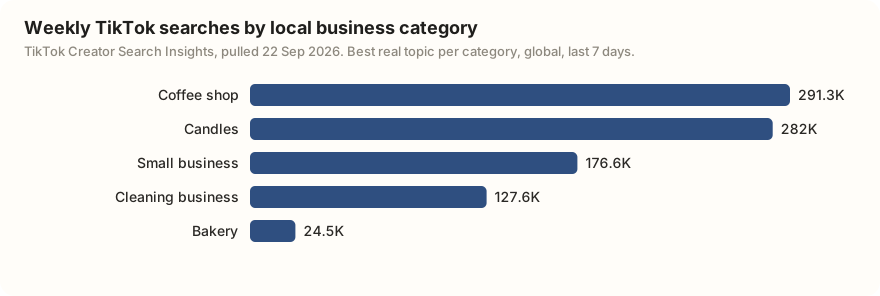
| coffee shop | Coffee shops | 291,312 | 0 | Real demand, no competition |
| candles | led candles | 281,971 | 1,097 | Real demand, some competition |
| small business | small business | 176,646 | 68,711 | Real demand, very crowded |
| cleaning business | Cleaning business | 127,612 | 5,031 | Real demand, beatable |
| bakery | Bakerys | 24,507 | 934 | Smaller, steady demand |
| handmade | handmade crafts and DIY ideas | 4,401,698 | 640 | Generated cluster, not a real phrase |
| boutique | shop and boutique locations | 4,768,029 | 859 | Generated cluster, not a real phrase |
| nail salon | nail salons and nail art | 2,356,535 | 904 | Generated cluster, not a real phrase |
Data: TikTok Creator Search Insights via TokConnect, pulled 22 September 2026. Global, last 7 days. Open the snapshot. Numbers over a million are TikTok's whole-category estimates, not counts of a single phrase.
Read the table in two halves. The top five rows are categories where people type a specific phrase often enough that TikTok keeps a real topic for it, with its own day-by-day history. "Coffee shops" is the standout: about 291,000 searches in a week and zero videos matched to it. That is demand with nobody answering it. "Cleaning business" gets about 128,000 searches against roughly 5,000 videos, which is competition a clear how-to can beat.
The bottom three rows look bigger and are worse. When we searched "handmade", "boutique" and "nail salon", TikTok did not hand back a phrase people type. It handed back a generated cluster: two nouns joined by "and", a popularity score in the mid-80s, and a curve that climbs from a few thousand to millions in seven days. Those million-plus numbers are TikTok's guess at a whole category, not proof anyone searches that exact phrase. We saw the same thing when we tried more specific words like "handmade jewelry" and "nail art": still clusters.
The lesson is not that nobody on TikTok cares about candles or nails. It is that a single broad word often will not match a real search. If you sell candles, "led candles" is a real topic with about 282,000 weekly searches; "candles" alone is a cluster. Plan on the specific thing you make, in the words a customer would use, and check each phrase before you commit to it.
A five-step TikTok marketing plan for small business
Here is the plan the data points to. It is built on your category's search demand, so every video has an audience waiting for it before you press record.
1. Find what your customers search in your category
Start with the phrases a customer would type to find a business like yours. Then check which ones are real. "Coffee near me late", "gel nails that last", "deep clean before and after", "sourdough starter for beginners": each is a phrase, and each either has demand or does not. TikTok's Creator Search Insights shows you, and our keyword research method walks one seed word through autocomplete and topic search into a ranked list with searches and video counts. If you have never opened the tool, this guide explains every number in it. Build the list before you build the videos.
2. Pick the formats that answer those searches
The real topics in the table are how-to and place questions, and four formats answer them well for a local business. A how-to video answers a search directly: "how we make our oat milk latte". A day in the shop puts a face and a place to a search like "Coffee shops". Before-and-after is built for services, which is why "Cleaning business" is beatable with a single satisfying clip. Behind-the-scenes of a candle being poured or a cake being iced turns a product into a reason to watch. Pick the format that fits the phrase you found, not the format that looks fun.
The most common mistake is copying whatever is trending and hoping the numbers rub off. A trend brings views from people who were never going to visit your shop. The 287K-view video with zero clients is what that looks like. A plain video that answers "is your bakery gluten free" reaches fewer people, but they are standing outside your door. Make the searched video first; make the trend video only when it also answers a search.
3. Put the search words in your captions and on-screen text
TikTok reads your caption and the words on screen to decide what a video is about. So use the exact phrase you found. If people search "cleaning business before and after", say those words on screen in the first second and put them in the caption. Do not write "transformation Tuesday" when the search is "before and after". Our caption guide has phrasing that ranks, and the TikTok SEO guide explains how the search side works. This one step is the difference between a video TikTok can file under a search and one it cannot.
4. Give people a way to buy
A found video is wasted if the viewer cannot act. If you sell physical products, TikTok Shop lets people buy without leaving the app; our setup guide covers eligibility and fees. If you sell a service or send people to your own site, put a clear link in your bio and point to it out loud. Shops and makers usually want both, and the ecommerce playbook works through the choice for a product business. Whichever you use, say the next step in the video: "the link is in our bio", "tap the yellow basket".
5. Set a cadence you can actually hold
The plan only works if you keep posting, so pick a pace you can sustain for months. Two solid videos a week that answer real searches will do more than seven rushed clips for two weeks and then silence. Batch a week's filming in one session so a busy shift does not end your streak. Our posting frequency guide shows what the numbers say by account size, and the content strategy guide turns your phrase list into a calendar ordered by demand and competition.
Run the check for your own category
Everything above came from a handful of searches against TikTok's data, and the same check runs for any business from one message. Replace the bracketed part with your business type and paste it into your AI agent.
Show me what people search for on TikTok around [my business type] so my videos have an audience. Search TikTok topics for the phrases a customer would type to find a business like mine, and for each give the best-matching topic with its 7-day searches and video count. Flag any topic whose 7-day curve climbs from a few thousand to over a million with a popularity of 85 or more as a generated cluster I should not plan on. Then list the real topics sorted by searches, mark the ones with under 1,000 videos as low-competition, and tell me the five phrases I should make videos for first.
Works in Claude, ChatGPT, Cursor and Gemini once TokConnect is connected. Get a free key (100 credits, no card) or see the setup guides.
If the phrases come back as real topics with beatable video counts, you have your first month of videos and the confidence that someone is searching for each one. If they come back as clusters, you have saved yourself weeks of posting into a feed that was never going to find you, and you know to try the specific thing you sell instead of the broad category word.
Frequently asked questions
Does TikTok marketing work for small businesses?
Yes, when a video answers something people in your category already search for. TikTok's own data showed steady weekly search demand for local categories like coffee shops, cleaning businesses and bakeries, and some of those searches had almost no videos answering them. A survey commissioned by TikTok Shop found 67% of shoppers use it to discover new products, and 72% of the brands they found were small businesses. It stops working when you post brand videos into the feed and hope one goes viral.
How do I start a TikTok for my small business?
Open a free TikTok account, switch it to a Business account in Settings, and add your location and a link in your bio. Before you film, list the phrases a customer would type to find a business like yours and check which ones people actually search. Then make short videos that answer those phrases and say the phrase out loud in the first three seconds.
What should a small business post on TikTok?
Post videos that match a search, not ads. The formats that earn views for local businesses are behind-the-scenes clips, how-to answers, a "day in the shop", and before-and-after. Take the exact wording from a search people already make in your category and answer it in 20 to 40 seconds.
How often should a small business post on TikTok?
Pick a pace you can hold for months, not a number you will quit in three weeks. Three to five videos a week is a common target, but two good ones every week beats seven rushed ones for two weeks and then nothing. Our posting frequency guide shows what the data says by follower size.
Do small businesses need TikTok ads or paid promotion?
No. The point of a search-led plan is that a free video answering a real search can be found for months without ad spend. Ads can speed up a launch, but they stop working the moment you stop paying. A video that ranks for a search keeps bringing people in. Start free and only pay once you know which videos convert.
How do I sell products from TikTok?
Two ways. TikTok Shop lets people buy inside the app; see how to set it up. Or send people to your own site with the link in your bio. Shops and makers who sell physical products usually want both, and our ecommerce playbook covers the choice.