 tokconnect
Define the sample before coding
Comment analysis starts with a selected video and a stated page boundary. Record the video URL or ID, the retrieval date, the requested count, the returned count, and the cursor. Those details tell a reviewer what the counts cover.
This guide uses one PUPG push-up-app video, aweme_id 7668908400243133726. A fresh 18 September 2026 video_comments result requested 50 comments at cursor 0. It returned 49 records, reported 215 total comments, hasMore: true, and nextCursor: 50. The findings below cover the 49 returned records, not the whole comment count.
{
  "name": "video_comments",
  "arguments": {
    "aweme_id": "7668908400243133726",
    "count": 50,
    "cursor": 0
  }
}
This is a tools/call argument fragment for a connected MCP client. Run a second page only when the research plan names that larger denominator.
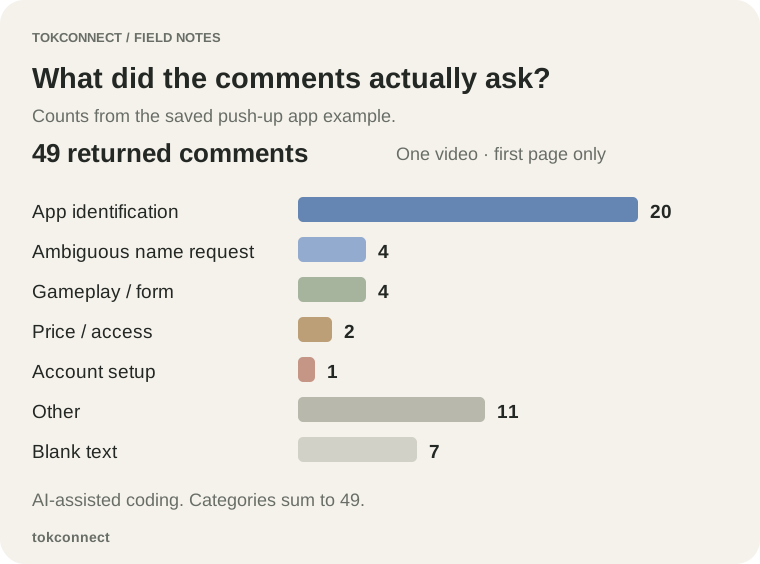
Use an explicit codebook
An AI-assisted editorial pass read each returned text and assigned one code under rules stored in the evidence file. “App identification” requires an explicit request for an app, application, website, game, or product name. “Ambiguous title request” captures name-only language that does not identify the object. That separate label prevents a loose rule from turning each occurrence of “name” into product intent.
| Code | Count of 49 | Rule |
|---|---|---|
| App identification | 20 | Explicit request for an app, application, website, game, or product name |
| Ambiguous title request | 4 | Asks for a name without identifying the object |
| Gameplay or form | 4 | Comments on challenge, form, or game mechanics |
| Price or access | 2 | Asks whether access costs money |
| Account setup friction | 1 | Mentions installation or account creation |
| Other or off-topic | 11 | Nonblank text outside these rules |
| Blank | 7 | No text |
The 49-row coding CSV includes each ID, text, assigned code, and coding note. It supports review of the count instead of asking a reader to trust selected quotations.
Handle language and ambiguity in the sheet
Translation changes a code decision. The Russian “Чеза приложения” was marked app identification because it asks about the app. The French “C est quoi le nom” was marked ambiguous title request because it asks for a name without naming an app. “name ?” carries the same ambiguity. The CSV records those notes beside the source rows.
These are AI-assisted classifications under explicit rules, not independent human validation. A human reviewer should recode the four ambiguous-title rows, compare decisions, and revise the rule before the team makes a higher-cost production decision.
Keep the source and denominator together
Use comment_replies only to clarify a selected comment. Replies carry the same source-video boundary and need their own cursor and count. Use another comment page when the plan requires it, then state the combined denominator and coding rule.
Pair the comment sheet with a topic brief and a bounded video result set. Those records can support a content test. They do not provide a representative survey, product analytics, or an audience demographic profile.
Save the completed sheet with the creative brief. The next edit can cite its specific source and rule. That record gives a client a clear reason for the test and a clear limit on the claim.
Audit the complete returned page
The evidence file and CSV include all 49 returned rows, including seven blank texts. The sample contains 20 explicit app-identification requests, four ambiguous title requests, four gameplay-or-form comments, two price-or-access questions, one account-setup report, 11 other-or-off-topic comments, and seven blanks. The counts add to 49. That reconciliation is the first check before anyone turns a category into a creative recommendation.
Count raw rows before likes. A liked comment can show that one wording drew attention; it cannot replace the denominator. For this page, the app-identification category has 20 of 49 rows, or 40.8% of the returned page. That calculation describes the coded sample. It does not mean 40.8% of all viewers, all 215 reported comments, or an addressable market wants the app name.
app-identification share of returned page
= 20 / 49 × 100
= 40.8%
Blank rows remain in the denominator because they were returned by the same request. Removing them would create a different measure: share of nonblank returned text. If you report that alternative, label it and show the calculation: 20 divided by 42 nonblank rows equals 47.6%. Neither value supports a population estimate.
Use AI-assisted coding with review
The sheet uses AI-assisted editorial classification under the stated codebook. It is not a manually coded research study. The review task is concrete: check the four ambiguous-title rows, the translated Russian and French rows, and any row whose code changes the script. A reviewer can keep the category, move the row, or add a second tag. If a row moves, update the CSV and all displayed counts together.
| Row type | How the codebook handles it | Review decision |
|---|---|---|
| “Name App ?” | App identification because the object is named. | Keep unless surrounding context changes the object. |
| “name ?” | Ambiguous title request because no object appears. | Check the video and nearby replies before treating it as product interest. |
| “Is it free?” | Price or access. | Verify current pricing before showing a price answer in a video. |
| “I tried to install it...” | Account setup friction. | Inspect the actual onboarding path before describing a defect. |
| Empty text | Blank. | Retain for the stated denominator. |
AI assistance can make the first pass practical; it cannot manufacture agreement between coders. For a paid creative decision, ask a second reviewer to recode a random subset or the decision-critical categories. Record disagreements and resolve the codebook before you rerun the totals.
Write a creative test from the codes
The source page supports one test: display the app name in the opening frame, then show a verified route to get it. The test answers the largest explicit request category in this sample. It does not require a claim about price. The two price-or-access comments justify checking whether the product has a simple, accurate access explanation; they do not justify stating a price in the video without current product confirmation.
Run the test against one otherwise comparable video or production batch. Track a pre-chosen outcome such as comments that ask for the name, landing-page clicks, or verified install starts. Keep the source-comment result separate from the outcome data. If name questions fall, the team learned something about that edit in that setting. It still has not measured all TikTok demand.