 tokconnect
A creator search produces leads, not partnership candidates. Build a shortlist from public records, describe the evidence that put each account on it, and leave rate, rights, availability, contact, and audience overlap as commercial checks. A small public sample can help a brand decide whom to review; it cannot prove a creator will accept a partnership or reach a particular buyer.
Set the shortlist rule
Start with the content job: for example, find coffee creators worth reviewing for a product demonstration. Define the audience, market, product category, minimum public evidence, and the number of accounts to hand off. Search one narrow phrase at a time: a format or role such as “barista,” then an activity such as “coffee brewing.” Record each exact query, date, result limit, and whether you searched public profiles or public videos.
Use profile fields to qualify only what they show. A handle, display name, bio, verification state, follower count, total likes, and video count can establish that an account exists and identify a visible category cue. They cannot identify the creator’s rates, contact details, past partnership results, full feed, audience demographics, or country fit.
| Criterion | Keep rule | Evidence to save |
|---|---|---|
| Category | Handle, bio, or returned videos match the brief | Exact public field or link |
| Content job | A reviewer can find relevant examples | Three public video links |
| Scale | No minimum until the brief sets one | Returned profile counts and date |
| Commercial fit | Unresolved at research stage | Owner and follow-up task |
Work the public records
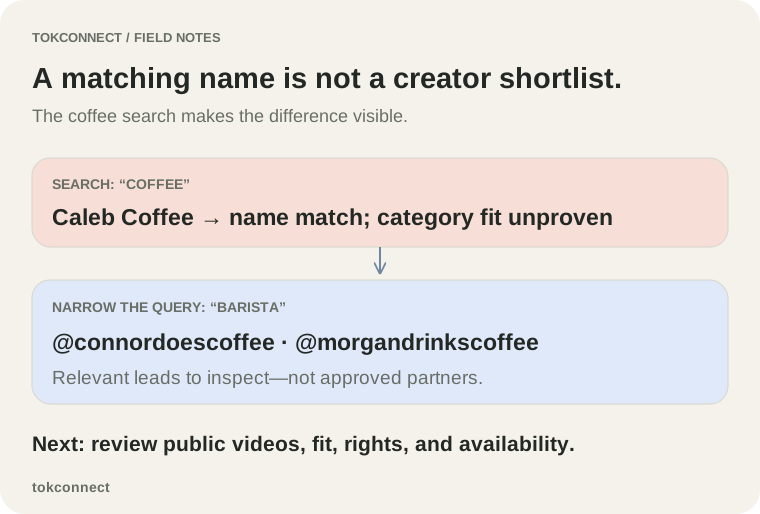
The saved September 18, 2026 creator retrieval searched barista and selected two records: @connordoescoffee, with 3,352,751 followers, 1,214 videos, 70,651,946 total likes, and verified status; and @morgandrinkscoffee, with 6,148,800 followers, 1,566 videos, 410,694,999 total likes, and verified status. A separate coffee brewing search selected @alternativebrewing, with 18,681 followers, 366 videos, 212,194 total likes, and verified status.
The account names and search words align with a coffee brief. That makes each record a lead for human review. It does not establish style, quality, audience overlap, an endorsement history, or a commercial relationship.
Reject the name match
The saved research also records that a broad search for coffee returned Caleb Coffee. The name match supplies no evidence that the account creates coffee-category content, so it belongs in the rejected log. The profile query for @lebo_coffee returned a Russian coffee-roaster bio, 663,400 followers, and unverified status. That bio is category context, yet it still leaves product fit and commercial suitability unresolved.
Keep a rejection log. It stops the team from rediscovering homonyms and lets the client see why a recognisable account failed the stated rule.
Review the same sample
For every kept lead, collect three public video URLs using the same review rule: recent returned examples that match the product job. Save the caption, public counts, retrieval date, and a reviewer’s observation. Distinguish returned text from what the reviewer saw. “Caption uses brewing vocabulary” can come from metadata. “Video demonstrates pour-over steps” requires a person to watch the public link and enter that observation.
Give the reviewer a bounded checklist: category relevance, product adjacency, safe claims, visible production quality for the brief, and any disclosed brand relationship. A pass does not grant usage rights. The commercial owner then requests a rate, availability, territory, deliverables, disclosure obligations, and permission terms through an approved contact route.
Search public creator records for [niche] and [format]. Return handle, visible profile fields, result query, date, and three relevant public-video links per kept lead. Reject name-only matches. Label public observations, reviewer observations, and commercial questions separately. Rank leads by match to [content job], not by follower count alone.
Deliver the shortlist
Brief: coffee product demonstration, public-research shortlist
Lead: @alternativebrewing
Evidence: search_users “coffee brewing”, 2026-09-18
Returned profile: 18,681 followers; 366 videos; verified true
Why kept: search phrase and account name align with brewing
Review sample: [three public links, captions, reviewer notes]
Commercial checks: contact, rate, availability, rights, audience fit
Status: review lead, not an outreach approval
Use the competitor workflow when the brief needs recurring public content patterns, and revisit the shortlist after the human review adds evidence.
Apply a campaign-fit matrix to the three leads
Use a working brief: a coffee-brewing tool needs a creator who can explain a preparation step, can place the tool in a plausible brewing context, and can supply three relevant public examples for review. Score category match, demonstration match, audience or market fit, and production fit. Public search supplies the first score; it does not fill the remaining columns. The matrix tells the research owner what to resolve before anyone discusses a deal.
| Lead | Observed evidence | Provisional score | Evidence gap | Next action |
|---|---|---|---|---|
| @alternativebrewing | Returned for “coffee brewing”; handle names brewing; 18,681 followers; 366 videos | Category 3/3; other fields pending | No selected public videos in saved file | Collect three links, then score whether each explains a brewing step |
| @connordoescoffee | Returned for “barista”; coffee handle; 3,352,751 followers; verified | Category 2/3; other fields pending | Role and handle do not show tool adjacency | Review three returned examples for preparation context |
| @morgandrinkscoffee | Returned for “barista”; coffee handle; 6,148,800 followers; verified | Category 2/3; other fields pending | No market, format, or disclosure evidence | Review three examples and document market signals |
Start with @alternativebrewing because the retrieval query is the most specific match to the brief. That order directs review effort; it does not rank partnership value. A reviewer can award demonstration points only after watching linked public examples. The commercial owner can then request rate, availability, rights, territory, and disclosure terms for leads that clear the content review.